Håfa Adai, everyone! Together with our friend Dabit Taitingfong, we’ll be teaching two in-person Chamorro language workshops at this year’s Chamorro Day Festival in Tacoma, WA, hosted by Guma’ Imahe. Information about our workshops is shown below, including registration links.
In addition to the workshops, Jay and I will be participating as vendors, selling Chamorro language greeting cards and stationery from my creative business, Bula Guinaiya. Hope to see you there!
Last Updated: May 18, 2026 – The date on the flyers has been corrected to read June 25, 2026.
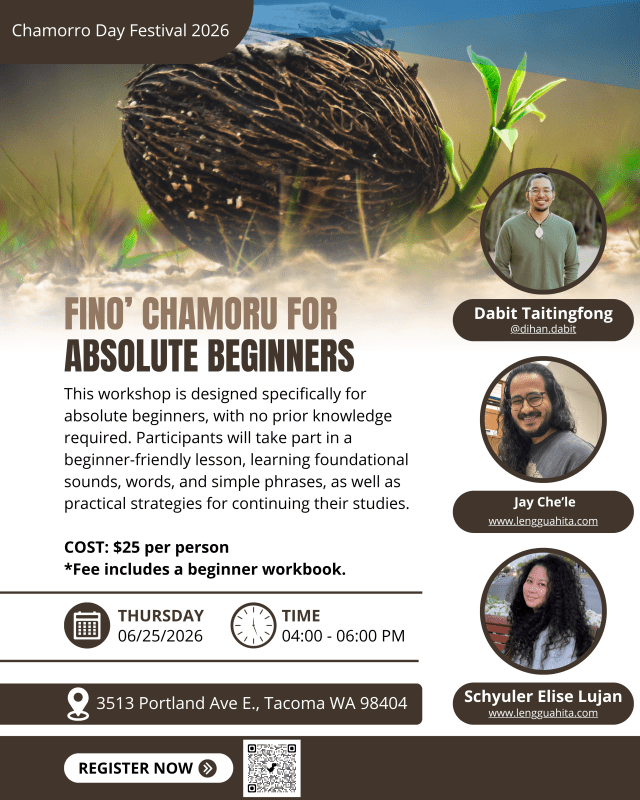
Fino’ Chamoru for Absolute Beginners
Event Details:
- Workshop Date: June 25, 2026
- Time: 4:00 PM – 6:00 PM (Pacific Time)
- Organization: Guma’ Imahe
- Community Event: Chamorro Day Festival 2026
- Location: Tacoma, WA
- Facilitators: Schyuler Elise Lujan, Juan Cruz Quintanilla, Jr., and Dabit Taitingfong
Registration Details:
Workshop Description: The Chamorro language connects us to our culture, our islands, and our elders and ancestors. For many of us, however—especially those who did not grow up speaking it—the language has felt distant or out of reach. This workshop is designed specifically for absolute beginners, with no prior knowledge required. Its goal is to set participants on a path toward long-term success in learning Chamorro as adults. Together, we will explore the historical pressures and present-day barriers that have shaped our relationship to the language, while also discussing key mindsets that help learners move forward with confidence. Participants will also take part in a beginner-friendly Chamorro lesson, learning foundational sounds, words, and simple phrases, as well as practical strategies for continuing their studies. By the end of the workshop, attendees will leave not only with a starting foundation in Chamorro but also with a clearer sense that learning the language is possible. Each participant will receive a self-study beginner Chamorro workbook to support continued learning beyond the workshop.
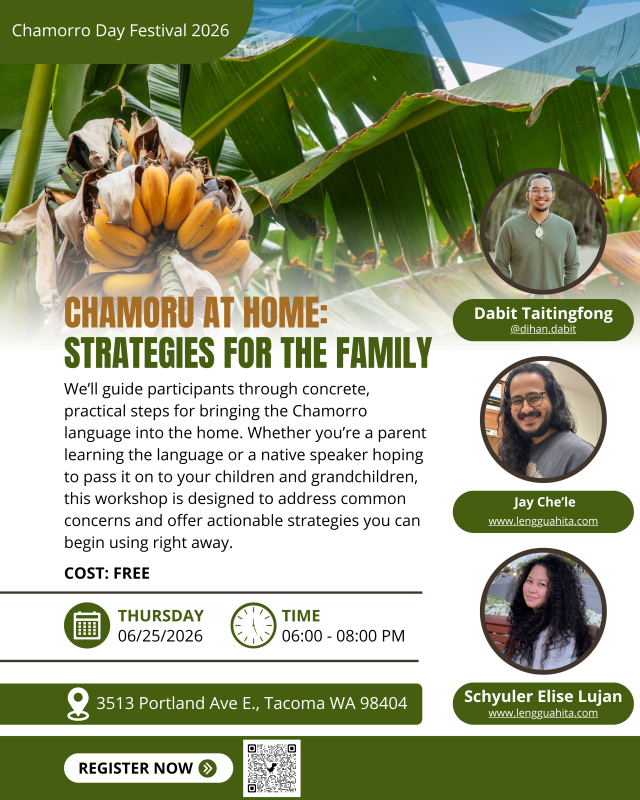
Chamorro At Home: Strategies for the Whole Family
Event Details:
- Workshop Date: June 25, 2026
- Time: 6:00 PM – 8:00 PM (Pacific Time)
- Organization: Guma’ Imahe
- Community Event: Chamorro Day Festival 2026
- Location: Tacoma, WA
- Facilitators: Schyuler Elise Lujan, Juan Cruz Quintanilla, Jr., and Dabit Taitingfong
Registration Details:
Workshop Description: Many families want to use more Chamorro at home but aren’t sure where to begin. Some may worry that they aren’t “fluent enough” to start. Regardless of how much Chamorro is currently used, the home remains one of the most powerful places for the language to live and grow. This workshop explores the dynamics of Chamorro language use in the home and addresses common concerns around speaking and using Chamorro in everyday family life. It is designed for anyone who wants to bring Chamorro into the home—whether you are a parent learning the language yourself or a native speaker hoping to pass it on to your children and grandchildren. By the end of the workshop, participants will leave with (1) a clear sense that using Chamorro at home is possible for every family member, regardless of current fluency; (2) concrete, actionable steps they can begin implementing right away; and (3) confidence that meaningful progress comes from consistent, low-stress practice—not immediate fluency.
 Lengguahi-ta