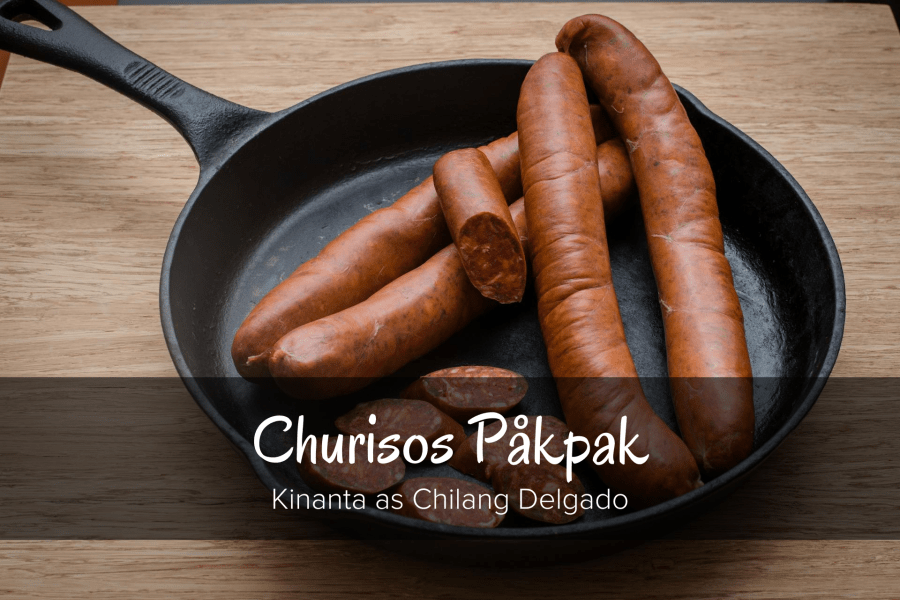
Two Saturdays ago our evening practice group listened to and transcribed Churisus Påkpak by Chilang Delgado. On the surface, the song appears to be about churisus påkpak, a sausage that is common in Chamorro kitchens and gets its name from the fact that it bursts open when cooked (hence the word påkpak which means “explode” or “pop”). But this is a song full of innuendo, and the churisus påkpak is just imagery to represent something else. It wasn’t until we reached the final lyric that it suddenly clicked for the group what the song is actually talking about. (Jay only had us listen to the audio, as the music video makes the underlying meaning obvious).
This post includes the music video, Chamorro lyrics, an English translation, language notes and a cultural context note for the song Churisus Påkpak by Chilang Delgado. Happy listening!
Lyrics
Cultural context note: In Chamorro culture, kumpairis and kumairis have typically shared a very close, family‑like bond, and it’s common to spend a great deal of time together. That closeness has sometimes led to marital tension. This song draws on that cultural backdrop, making the choice of kumpairis and kumairis a deliberate framing that highlights a culturally specific dynamic.
It’s the kind of sausage that if you bite it, it explodes
Yanggen un åkka’ na churisus, påkpakpak
It’s the kind of sausage that if you bite it, it explodes
Yanggen un åkka’ na churisus, påkpakpak
It’s the kind of sausage that if you bite it, it explodes
Yeehaw!
Yeehaw!
Song transcription and translation developed collaboratively by the Praktikan Pupuengi online Chamorro language practice group, led by Jay Che’le on April 4, 2026.
Notes
påri: This term is short for kumpairi, which does not have a direct English translation. Your påri can be your child’s godfather or the father of your godchild. From the godchild’s perspective, this person is their nino. We may hear younger people these days (even young children!) calling each other påri as an approximation for a “friend”, but that usage seems to come from a misunderstanding of what the term actually represents (a spiritual relationship between the parents of baptized children) and the fact that a great many people can be someone’s påri. ↩︎
kumairi: This is the long-form for the term måli’, which also doesn’t have a direct English translation. Similar to påri, your måli‘ can be your child’s godmother or the mother to your godchild. From the godchild’s perspective, this person is their nina. ↩︎
Pau: This is a contraction of para u, which indicates future tense (“he will”). ↩︎
fa’maoliki: The root word is maolek, which means “good”. When you fa’maolek something, it can mean that you are fixing or repairing it. Turning it into fa’maoliki with the -i suffix means you are repairing something for someone else.↩︎
fabot: Most learners are most familiar with the phrase pot fabot (“please”). But fabot is also used by itself, to mean “a favor”. ↩︎
chuli’i: The root word is chuli’ which means “to take, to bring”. Adding the -i suffix at the end transforms it to mean “to take / bring for someone“. ↩︎
Yanggen un åkka’ na churisus, påkpakpak: You may want to translate this lyric as “If you bite the sausage, it explodes”, but that’s not exactly what she is saying here. There is a more subtle nuance because ofthe linker na. The first part of the sentence Yanggen un åkka’ (“if you bite it”) is being used to describe churisus (“sausage”). Essentially, she is telling us what kind of sausage it is. This may feel awkward from an English language perspective because English doesn’t let us use “if statements” as descriptors. This means we need different words in English to capture the thought: “It’s the kind of sausage that when you bite it, it explodes”. ↩︎
chåda’ fresku:This literally translates to “fresh eggs”, but in the Chamorro language, the word chåda‘ (“egg”) is used as a slang term for “vagina”. This is why we often need to be careful with how we use the word chåda’ – used in the wrong way, with the wrong tone, and you could give the impression of being disrespectful and talking about something inappropriate.
As an additional note, Jay says that the inclusion of this lyric seems to frame the entire song as a reply to another Chamorro song called Chåda’ Fresku. ↩︎
 Lengguahi-ta