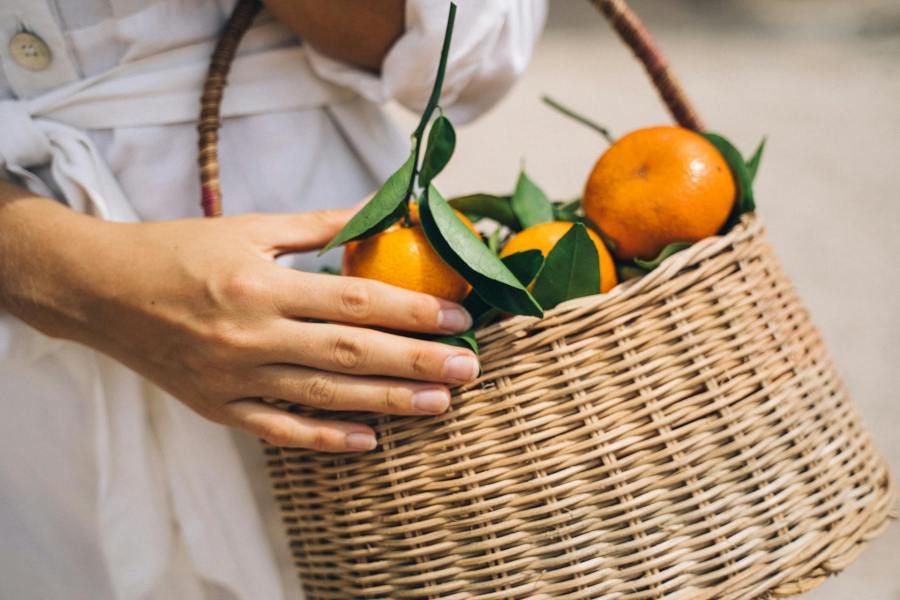
Chamorro has general words for “here” and “there”, and we typically use them to describe where someone or something is located or headed. But we can also use these words to express doing an action on the way to a place, such as “Bring the medicine on your way here” or “Bring the fruit on your way to the party.” This is another pattern that adds subtle complexity in how we express ourselves in everyday conversation. In this post, we’ll start learning this pattern, but we’ll keep things simple by practicing with just two Chamorro words: “bring it on your way here” and “bring it on your way there.”
Un dångkulu na Si Yu’us ma’åse’ to our Aunty Faye Untalan for answering our questions about this language pattern, and also to our teacher Ray Barcinas for teaching us about this topic.
As always, this post includes example sentences in Chamorro, English translations, and Chamorro audio narrations by Jay Che’le. Happy studying!
Contents
Chamorro Location Words: Mågi and Guatu
Chamorro has two location words, which are used when we are talking about movement to or from somewhere. These words are in the table below:
| Chamoru | English |
|---|---|
| mågi | here (where I am) |
| guatu | there |
What’s interesting about Chamorro is that these location words can be used as suffixes, meaning that we can attach them to the ends of verbs to add more nuance to our speech. When we attach the location word to a verb, we create something known as a compound directional word or a compound movement word. 1
This means we create a word that describes an action that is happening while we are also going in a specific direction.
For example:
- Pick some mango on your way in.
- Go to the store on your way here.
- Take out the trash on your way out.
In this lesson, we’ll practice these kinds of sentences using the location words mågi (“here”) and guatu (“there”) with the verb chuli’ (“to take/bring”). We will also practice with many example sentences to help solidify our understanding of their meanings, which will help us learn and use other location words and verb combinations.
In the next section, we will get started by making our new words with mågi, guatu, and chuli’.
Core Pattern: “Bring it on your way.“
Now we will practice attaching our Chamorro location words to the end of chuli’ and the location word as two separate words; we’ll be combining them into a single word, resulting in a brand new word with a different meaning.
We will follow this pattern:
| chuli’ + location word |
Our new words are in the table below. Make sure to also listen to the audio pronunciations, because both the pronunciation and stress placement have shifted slightly:
| Chamoru | English |
|---|---|
| chulé’magi | (Transitive Vb.) to bring [something] on your way here |
| chulé’guatu | (Transitive Vb.) to bring [something] on your way there |
🗣️Pronunciation Notes: The final vowel in chuli’ undergoes vowel lowering, meaning we see the final “i” sound lowered to an “e” sound. Additionally, since we are pronouncing this as a single word rather than two separate words, the stress shifts.
If you are still unsure about how these new words have a different meaning from saying chuli’ guatu or chuli’ mågi, let’s do a comparison and contrast of meanings in the table below:
| As Two Words | As One Word |
|---|---|
| chuli’ guatu to bring something there | chulé’guatu to bring something on the way there |
| chuli’ mågi to bring something here | chulé’magi to bring something on the way here |
❓What is the difference in meaning? There is a difference in the implied purpose of the two sets of verbs. When you are told to bring something to the party, it implies that your main purpose is to deliver that item to the party.
But when you bring something on your way to the party, it implies that you were already going to the party, and you will be picking up something on your way there. You will be doing the action of picking something up (an additional action) while heading in the direction of the party.
How to Say “Bring it on your way here.“
To get used to these words, let’s first use chulé’magi in some basic command sentences. In these sentences, we will be telling someone to bring [something] on their way over here.
We’ll follow this basic structure:
| Chulé’magi + [ i + Object ] |
Now let’s practice some example sentences in the table below:
| Chamoru | English |
|---|---|
| Chulé’magi i amot. | Bring the medicine on your way here. |
| Chulé’magi i tilifon-hu. | Bring my phone on your way here. |
| Chulé’magi i buteyan hånom. | Bring the water bottle on your way here. |
Great job! In the next section, we will practice with our second word, chulé’guatu.
How to Say “Bring it on your way there.“
In this section, we’ll make some practice sentences with chulé’guatu, which translates to “bring [something] on your way there.” We’ll make sentences with this pattern:
| Chulé’guatu + [ i + Object ] |
And some example sentences are in the table below:
| Chamoru | English |
|---|---|
| Chulé’guatu i tinala’ kåtni. | Bring the dried meat on your way there. |
| Chulé’guatu i salappi’. | Bring the money on your way there. |
| Chulé’guatu i yabi. | Bring the keys on your way there. |
And that wraps it up for our most basic sentences with chulé’magi and chulé’guatu. In the rest of the lesson, we’ll practice adding a little more detail to these sentences.
Adding Locations: “Bring it on your way to the party.“
In our sentences with chulé’guatu, we can also specify a location by adding a location at the end of the sentence. To do this, remember to use the location marker gi. The structure we’ll practice with is shown below:
| Chulé’guatu + [ i + Object ] + [gi + Location] |
Now let’s modify some of our previous sentences by adding a location. Example sentences are in the table below:
| Chamoru | English |
|---|---|
| Chulé’guatu i tinala’ kåtni gi gipot. | Bring the dried meat on your way to the party. |
| Chulé’guatu i salappi’ gi tenda. | Bring the money on your way to the store. |
| Chulé’guatu i yabi gi kareta. | Bring the keys on your way to the car. |
Making It More Polite With Fan or Kao Siña
The above sentences are commands and might seem abrupt, but we can soften them by adding fan (the polite marker) or kao siña (can). First, let’s practice with the polite marker fan, which we’ll add after the verb:
| Chulé’magi / Chulé’guatu + fan + [ i + Object ] |
| Chamoru | English |
|---|---|
| Chulé’magi fan i amot. | Please bring the medicine on your way here. |
| Chulé’magi fan i tilifon-hu. | Please bring my phone on your way here. |
| Chulé’magi fan i buteyan hånom. | Please bring the water bottle on your way here. |
| Chulé’guatu fan i tinala’ kåtni gi gipot. | Please bring the dried meat on your way to the party. |
| Chulé’guatu fan i salappi’ gi tenda. | Please bring the money on your way to the store. |
| Chulé’guatu fan i yabi gi kareta. | Please bring the keys on your way to the car. |
🛑A Word of Caution About Fan: Although fan is a polite marker, remember that it may be considered impolite to use this term with people who are older than you, or who are otherwise above you in status. If you are ever in doubt, try using kao siña instead.
Now let’s practice a second way of softening these sentences by adding a kao siña un (can you?) at the beginning of our sentences. The sentence structure is below:
| Kao siña un + chulé’magi / chulé’guatu + [ i + Object ] |
| Chamoru | English |
|---|---|
| Kao siña un chulé’magi i amot? | Can you bring the medicine on your way here? |
| Kao siña un chulé’magi i tilifon-hu? | Can you bring my phone on your way here? |
| Kao siña un chulé’magi i buteyan hånom? | Can you bring the water bottle on your way here? |
| Kao siña un chulé’guatu i tinala’ kåtni gi gipot? | Can you bring the dried meat on your way to the party? |
| Kao siña un chulé’guatu i salappi’ gi tenda? | Can you bring the money on your way to the store? |
| Kao siña un chulé’guatu i yabi gi kareta? | Can you bring the keys on your way to the car? |
And that wraps up all of our practice drills. Great job!
Summary
This was an introductory post on how Chamorro can attach location words to the end of a verb to express doing an action while heading in a specific direction.
To keep things simple, we practiced only with the words mågi, guatu, and chuli’ to express the idea of bringing something on your way here or on your way there. We did the following:
- Made basic sentences with the words chulé’magi and chulé’guatu
- Added locations
- Softened these commands with fan and kao siña
These notes were distilled from a lecture given by our Chamorro language teacher, Ray Barcinas. We also had a conversation with Dr. Faye Untalan about this topic, during which she provided further clarification on this language pattern.
Documentation & Further Study
Notes
- Kumisión I Fino’ CHamoru Yan Fina’nå’guen I Historia Yan Lina’la’ I Taotao Tåno, Utugrafihan CHamoru Guåhan, PDF, 3rd ed. (Hagåtña, Guam: Kumisión i Fino’ CHamoru, 2024), 102, https://kumisionchamoru.guam.gov/wp-content/uploads/2025/09/Utugrafihan-CHamoru-GuaIhan-3rd-Ed-2025-09.03.25_compressed.pdf ↩︎
References
Kumisión I Fino’ CHamoru Yan Fina’nå’guen I Historia Yan Lina’la’ I Taotao Tåno’. Utugrafihan CHamoru Guåhan. PDF. 3rd ed. Hagåtña, Guam: Kumisión i Fino’ CHamoru, 2024. https://kumisionchamoru.guam.gov/wp-content/uploads/2025/09/Utugrafihan-CHamoru-GuaIhan-3rd-Ed-2025-09.03.25_compressed.pdf.
 Lengguahi-ta