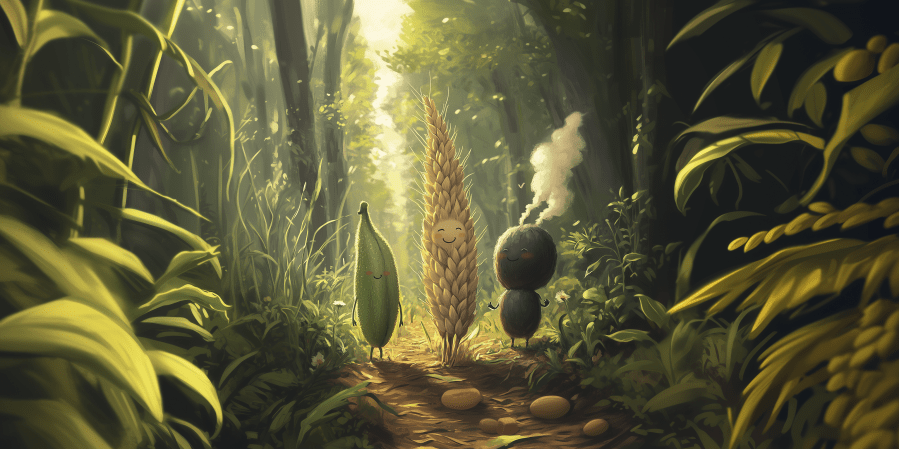
Here is another fairy tale from the Grimm Brothers, about a straw, a coal, and a bean that seem to escape their fate, only to fall into misfortune later. This version was translated by Dolores Marciano and includes an audio narration in Chamorro by Jay Che’le, the Chamorro text, an English translation, and a link to the original source document. Happy reading!
I Ngasan, I Katbon Yan I Monggos
Tinige’ nu i chume’lu as Grimm
Pinila’ as Dolores Marciano
Un talo’ani anai monhayan este i biha ha rikoi todu i monggos gi un tasson, ha tutuhon muna’fandanna’ i ngasan gi halom i feggon pot para u totnge i guafi. Gi anai ha basísiha hålom i monggos gi satten ni eståba gi hilo’ i guafi, ti ha ripara anai poddong huyong ginen i satten un manggos ya gaige na oggan gi hilo’ satge anai eståba un ngasan. Ti apmam manggaloppe huyong un katbon ginen i halom i feggon ya eståba lokkue’ gi fi’on i ngasan yan i monggos.
“Ai amigu, mangginen manu hamyo mågi?”
“Ginen ennao yo’ hålom gi feggon. Buente yanggen ti hu laknos yo’ ginen ennao hålom gaige yo’ na mama’åpu nu i finigan-ña,” manoppe i katbon.
“Guahu lokkue’ hu eskapayi i biha, sa’ yanggen ti hu cho’gue este, gaige yo’ på’go na mama’ya’ gi halom i kaddon monggos.”
“Pues mamparehu hit na estao nai manggaige sa’ gof tailayi ha’ este na biha. Tai konsiderasion nu hita. Esta monhåyan ha songge mas ki sisienta na mañe’lu-hu. Suette na hu eskapåyi gue’ sinu esta lokkue’ hu sodda’ i finatai-hu.”
“Lao, håfa pa’go para ta cho’gue?” mamaisen i katbon.
“Buenti maolek yanggen mandanña ha’ hit ya ta espiha månu nai siña hit manlå’la’. Esta monhåyan ta eskapåyi i finatai-ta pues maolek ta espiha månu hit guatu,” manoppe i monggos.
Pues mandanña’ i tres ya manhånao gi hinanao-ñiha. Para u ma’aligao månu nai siña siha manlå’la’ yan u fanggai minagof.
Anai esta lá’apmam siha gi kareran-ñiha manmåtto gi un såddok anai debi ha di u ma krusa este na såddok pot para u fanmalak i otro bånda na lugåt. Ti ma tungo’ håfa para u ma cho’gue estaki manhasso i ngasan ya ilek-ña, “Bai hu estira yo’ guatu esta i otro bånda, kosa ki siña hamyo en fanmamokkat gi atayo’-hu kulang un tollai.”
Magåhet na ha estira gue’ i ngasan. Kahulo’ i katbon ya guiya fine’nena mamokkat gi hilo’ i ngasan. Sumen maolek todu i sinesedi mo’na estaki matto ha’ i katbon gi talolo’ gi atayo’ i ngasan ya ha hungok i burukan i hanom gi papa’-ñiha. Humuyong esta ni mo’na gue’ pat sino hu hånao tåtte. Uttimo-ña kimasson i ngasan ya poddong hålom esta i halom hånom. Tåtatte lokkue’ i katbon hålom esta halom hånom ya sumén måtai.
Duru i monggos ni chakka’ chalek-ña anai ha li’e’ este i siniseden i dos na amigu-ña. Duru di chumålek ya kana’ ti ha háhago’ hinagong-ña sa’ ti siña pumåra chumålek. Uttimo-ña makta i un banda giya guiya. Sen suette sa’ måtto un såstre ya rinipara gi kanton i saddok. Gof yo’ase’ este i sastre sa’ ha lakse i monggos tåtte nu i haguha-ña yan i hilon åttilong. Ayu na guaha kulang linaksen hilon attilong gi un bånda este i monggos yanggen un gof ripara.
The Straw, The Coal, and The Bean
Written by the Brothers Grimm
Translated by Dolores Marciano
One afternoon when this elderly woman was finished collecting all of the beans in a bowl, she started to gather together the hay inside the stove to light the fire. When she was pouring out the beans into the pot that was on top of the fire, she did not notice when one bean fell out from the pot and ended up on top of the floor where there was a straw. Soon, one coal jumped out from inside of the stove and it was also next to the straw and the bean.
“Oh friends, where did the two of you come from?”
“I came from inside the stove. Probably if I did not take myself out from in there, I would be turned to ash by her cinders.,” the coal answered.
“Me too, I escaped the elderly woman because if I didn’t do this, right now I would be floating inside the bean soup.”
“Then we are of the same situation because this elderly woman is very evil. She has no consideration for us. She has already finished burning more than seventy of my siblings. It’s lucky that I escaped her, or else I would also have found my death.”
“But what will we do now?” the coal asked.
“It’s probably good if we just get together and we search for where we can live. We have already escaped our deaths, so it’s good if we search for were we will go,” the bean answered.
So the three got togetherand went on their journey to look for where they could live and to have happiness.
When they were already on their journey for some time, they arrived at a river where they needed to cross this river to go to place on the other side. They didn’t know how they would do this until the straw thought and said, “I will stretch myself toward the other side, so that you can walk on my back, like a bridge.”
And truly, the straw did stretch itself. The coal climbed up and it was the first to walk on top of the straw. The experience forward was very until the coal got to the middle of the back of the straw, and it heard the noise of the water underneath them. It came to be that it could not go forward, or go back. In the end, the straw burned and fell into the water. The coal also followed into the water, and it really died.
The bean kept cackling when it saw this experience of its two friends. It kept laughing and it was as though it could not catch its breath, because it could not stop laughing. In the end, one of its sides split. It was very lucky because a tailor arrived and noticed him on the riverbank. This tailor was very merciful, because he sewed the bean back with his needle and black thread. That is why it is as there there is a black seam on one side of this bean, if you really notice it.
Source
Dolores Marciano, “I Ngasan, I Katbon yan I Monggos,” KPV Collection, accessed November 25, 2024, https://airtable.com/appU43QeD409YS6Hl/shrXhl6F1kRn9xx1H/tblN01VTDCNtsL5Er/viweMEfQRRSfWjSvi/reccyZ0mDFKhI1Asu/fldJcH5PQ1juSBRbo/attMbW26mXZ1AuQLf?blocks=hide
 Lengguahi-ta