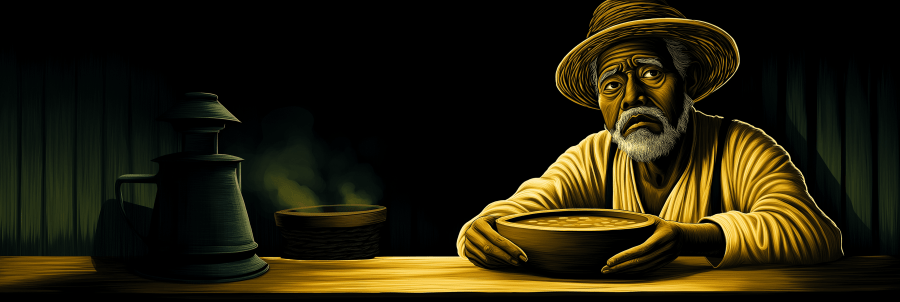
As a child I owned a copy of the tales collected by the Grimm Brothers, and whenever I didn’t know what to read I would choose a fairy tale at random and lose myself in the story. It was like my analog version of a Kindle back then 🙂 “The Old Man and His Grandson” is one of the shorter tales from their collection, and perhaps you have never heard of it. But it has stuck with me since I first read it over 20 years ago and it has always been at the top of my list of stories to translate into our language. In this post, I am excited to share my translation of this story, which was edited by my Chamorro language teacher Ray Barcinas and my fellow learner Jesus Lujan. This post includes the Chamorro text, a Chamorro audio narration by Jay Che’le, notes on word usage, and the English version of the story. Happy reading!
I Amko’ Yan I Patgon-ña Toyong1
Tinige’ nu i Chume’lu as Grimm
Pinila’ as Schyuler Lujan
Nina’lágåsgas as Ray Barcinas yan as Jesus Lujan
Tumaiguini2 guaha sen åmko’ na taotao ni cháchatmata3, ya mappot manhungok, lálalao i temmo-ña, ya annai matå’chong gi lamasa, ti sísiña ha go’te i kuchåla ya sesso ha chuda’ i na’-ña kaddo’ gi hafyin lamasa4, osinó milak påpa’ ginen i pachot-ña.
Nina’måssa’5 i lahi-ña yan i asagua-ña nu enao, pues mana’fatå’chong i amko’ gi tatten feggon, ma po’lo i na’-ña gi mo’ok6, ya ti nahong. Ginen eyu, tumalakguatu i amko’ gi lamasan-ñiha, ya kuméketanges.
Humuyong na ti siña ha go’te i amko’ i sahguan sa’ i lálaolao na kannai-ña, ya poddong gi satge, ya måffak. Linalåtde nu i hoben na asaguan lahi-ña, lao tåya’ sinangån-ña i amko’, sumospiros ha’. Pues ma fahåni i amko’ sahguan håyu ni baråtútu, ya ginen eyu na para u kånno’ i na’-ña. Taiguihi manmatå’chong siha annai i dikike’ na påtgon låhi ni kuatro sumakkån-ña7 ha tutuhuni manhokka’ håyu gi sanhiyong.
“Håfa bidåda-mu?” mámaisen i tata.
“Mama’títinas yu’ dikike’ na sahguan nengkånno’,” manoppe i patgon, “para i na’-miyu yan si nåna yanggen dumångkulo yu’.”
Umáli’e’ matan-ñiha i lahi yan i asaguå-ña, ya ti apmam kuméketanges. Pues ma esgaihon i amko’ guatu gi lamasa, ya ginen ayu, mañisiha mañocho, ya tåya’ sinangan-ñiha yanggen håfa chinidå-ña8.
The Old Man and His Grandson
Written by The Brothers Grimm
Translated by Schyuler Lujan
Edited by Ray Barcinas and Jesus Lujan
There was once a very old man, whose eyes had become dim, his ears dull of hearing, his knees trembled, and when he sat at table he could hardly hold the spoon, and spilt the broth upon the table-cloth or let it run out of his mouth. His son and his son’s wife were disgusted at this, so the old grandfather at last had to sit in the corner behind the stove, and they gave him his food in an earthenware bowl, and not even enough of it. And he used to look towards the table with his eyes full of tears.
Once, too, his trembling hands could not hold the bowl, and it fell to the ground and broke. The young wife scolded him, but he said nothing and only sighed. Then they bought him a wooden bowl for a few half-pence, out of which he had to eat. They were once sitting thus when the little grandson of four years old began to gather together some bits of wood upon the ground.
“What are you doing there?“ asked the father.
“I am making a little trough,” answered the child, “for father and mother to eat out of when I am big.”
The man and his wife looked at each other for a while, and presently began to cry. Then they took the old grandfather to the table, and henceforth always let him eat with them, and likewise said nothing if he did spill a little of anything.
Notes
1 patgon-ña toyong: His/her grandchild. The word toyong is one we learned from Ray Barcinas.
2 tumaiguini: This literally means “became like this” but according to Ray Barcinas, this is also an expression used in Chamorro storytelling when you begin a story.
3 cháchatmata: The root word is chatmata which means “partly blind; poor vision.”
4 hafyin lamasa: Tablecloth, table covering
5 nina’måssa’: Made to be repulsed, sickened or nauseated. The root word is måssa’ and is transformed with the causitive na’- and -in- infix.
6 mo’ok: Clay bowl. We learned this word from Ray Barcinas. He says that the word is fossilized in this form, so vowel harmony doesn’t apply.
7 kuatro sumakkån-ña: This translates to ” he/she/it is four years old.” Rather than using åños or idat to talk about age, we can use såkkan which means “year.”
8 yanggen håfa chinidå-ña: This is literally “when he would have spillage.” The word to pay attention to is chinidå-ña which comes from the word chuda’ which means “to spill.” When we transform it with the in infix and add the possessive pronoun at the end, it becomes akin to “his/her/it’s spillage” or “what he/she/it spills.”
Source
English Version Source: https://www.childstories.org/en/the-old-man-and-his-grandson-1737.html
 Lengguahi-ta