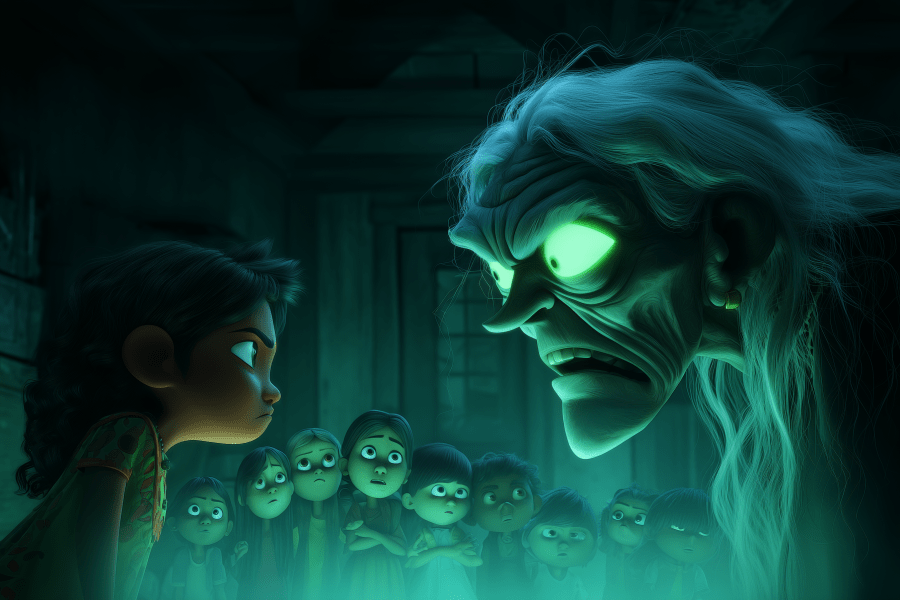
As we near the end of October, we’re fully into the fall here in Oregon. Days continue to shorten, leaves are transitioning through golden yellow and red hues, and the air has taken on a crisp chill. To mark the season, we’ll be reading a particularly spooky story in our Saturday practice this week. This story is about a large family who must contend with an unexpected threat. While mom and dad are away for several days on an errand, the eldest amongst eleven fulfills her duty in keeping everyone safe and ensuring their chores are done by bedtime.
In this post, you’ll find the Chamorro text, an English translation, language footnotes, and an audio narration by Jay Che’le. Happy reading!
Estorian I Tailayi Na Biha
Tinige’ as Dolores Marciano
Eståba un familia na mañåsaga gi lancho. Sumén chågo’ i lugåt anai mañåsaga kontra i sengsong. Tåya’ lokkue’ siha bisinon-ñiha. Kasi i mas hihot na bisinon-ñiha gaige na dos miyas i chinago’-ña. I tata gumågualo’ yan i asagua-ña umayúyuda gue’ yan i mandånkolo na famagu’on-ñiha. Guaha onse na famagu’on guini na familia. Mansén hoben este siha na famagu’on sa’ mampos mandikike’. I mas åmko na påtgon trabiha kinse åños ha’ na sotterita.
Un dia anai mañésena siha i familia gi halom i lanchon-ñiha, maninabisa nu i tatan-ñiha na para u faná’ayuda gi gima’ yan i gualo’ sa’ para u karera yan i nana para i sengsong pot guaha siha mantension para u fanmachule’ para i familia.
“Ya håyi para u inatan ham?” mámaisen i sotterita.
“Tåya’, siña ha’ hamyo en faná’ayuda sa’ tåya’ piligru siña u fåtto guini. Hagas ha’ hit mañåsaga guini lao tåya’ estotbo pat piligru guini gi lugåt-ta. Gof adahi ha’ i che’lon-miyu. Sósongge i danges yan i fallot gigon hóhomhom kosa ki manlisto hamyo åntes di u puengi. Fandeskåkansa tåftaf kosa ki siña hamyo en fanmakmåta lokkue’ åntes di u manana.”
Kulang nina’ma’å’ñao i patgon, lao pot no u linalatde nu i tata mamatkilu ha’ ya ha aksepta i matago’-ña.
Guihi lokkue’ gi sigiente dia, ma’arekla siha i dos saina ya ma toktok pues ma chiku i famagu’on-ñiha unu in unu. Pues ma’abisa ta’lo i patgon na para u adahi siha i mañe’lu-ña.
“Adahi lokkue’ na un baba i petta1 an puenge maseha håyi manyå’ho. Adahi na un na’halom gi gima’. Siempre bai in bíbira ham tåtte gi halom i dos dias,” ilek-ña i tata nu i mas åmko’ na hagå-ña.
“Gof adahi lokkue’ i che’lon-miyu, hågu hagå-hu gof pulan maolek i neni sa chatsaga bai hu konne’ para i sengsong. Mampos chågo i destansia ya tåya’ kareta,” ilek-ña i nana.
Manótohge ha’ i dies na famagu’on gi me’nan i lancho. I neni gaige na hinéhegue nu i sotterita na palao’an. Ma’á’atan ha’ i mañainan-ñiha anai humåhanao i dos para i sengsong. Manótohge ha’ guihi gi me’nan i lanchon-ñiha asta ki manmalingu i mañainan-ñiha. Anai esta ma li’e na ti mana’annok esta mansinangåni nu i che’lon-ñiha na para u ma arekla siha ya u ma tutuhon i tarehan-ñiha pot håfa siha para u fanmacho’gue gi lanchon-ñiha.
I primet noche anai para u fandeskansa i famagu’on, mahungok i ga’-ñiha ga’lågu na duru humaohao. Kulang ayu na klåsen kåti i manlíli’e’ mohon ti maolek na taotao pat sino ånimas. Kahulo’ i sotterita ya ha espiha i mañe’lu-ña pot para u na’fantrankilu i hinasson-ñiha. Duru di ha estoriåyi siha i mañe’lu-ña, ayu siha i mannámagof na klåsen estoria. Ti apman ma hungok na pumara i ga’lågu di humaohao. Sumilénsiosio i uriyan i lancho ta’lo, gof pasífiku i uriyå-ña.
“Fanmaigo’ sa’ manmámaolek ha’ hit. Tåya’ piligru u fåtto giya hita. Agupa’ ha’ gi pupuengi mågi si tåta yan si nåna.” Duru di ha kombense i mañe’lu-ña pot para u fandeskånsa.
Magåhet na mandeskånsan maolek i famagu’on. Lao gof ná’ma’ase’ i palao’an sa’ matåtå’chong ha’ ya ha atan ha’ i mañe’lu-ña. Kada biråda petchao kada manhungok fina’kalaskas. Sigi ha’ lokkue di sumikat lao humahnánao ha’ ti maigo’.
Gi sigiente ogga’an kahulo’ ya ha arekla i nenkånno’ para i famagu’on. Despues di manmonhåyan gi sentåda manhånao ya ma cho’gue i tarehan-ñiha gi lancho. I amko’ na påtgon låhi munana’chocho babui, i dos dikike’ na påtgon låhi manmangguaguasan gi fi’on i tinanom nappa’ yan i tinanom ripoyu siha. Kada kuat2 yan i che’cho’-ñiha.
Anai esta lálapuengi, esta ta’lo i patgon palao’an kulang nina’chathinasso sa’, ti á’annok mågi si nanå-ña yan si tatå-ña. Duru lokkue’ i famagu’on di manatborutao lao ensigidas ha’ ta’lo manmamatkilu sa’ sigi mankuinentusi nu i che’lon-ñiha. Ha gof tungo’ kumuentos yan kumombense i mañe’lu-ña.
Ayu lokkue’ na puengi, duru ta’lo i ga’-ñiha ga’lågu di humaohao. På’go na biahi kulang ayu i para u gutos ha’ i enemigu-ña ni atborutu-ña. Duru lokkue’ i katu di mamburuka. Manatborutao i ga’ga’ gi sagan-ñiha. Esta mansén ma’å’ñao i famagu’on gi halom guma’ lao manmamatkíkilu ha’ sa’ duru ta’lo i che’lon-ñiha di kumånta ni mambunitu siha na kånta. Ayu na kånta i taya’ nai ma hungok. Ti ha tungo’ lokkue’ i sotterita håfa siha i kantåta-ña lao magåhet na mandeskånsan maolek ha’ i mañe’lu-ña taiguihi ha’ ta’lo i sinisedi gi maloffan na puengi. Ensegidas sumilénsiosio i uriyan i lancho.
Magåhet na gi mina’tres dias dipotsi para u fanmåtto i tata yan i nana lao ma disidi na para i sigiente dia na para u mabira siha tåtte gi lancho sa’ pot para u fanggupot yan i manátungo’-ñiha ni pa’go malíli’e. Ayu na ti mabira siha tåtte gi mina’tres noche.
Guihi lokkue’ gi mina’tres noche anai eståba i famagu’on na mañésena, ma hungok na guaha manyåyå’ho gi petta. Hinasson-ñiha i famagu’on na i mañainan-ñiha, manmalågu todu para i petta. Anai ha baba i sotterita i petta ma li’e’ na eståba un sén biha na palao’an na manchináchatge.
“Kao siña en na’deskansa yo’ guini? Ginen i lancho yo’ para i sengsong ya ha gacha’ yo’ i puengi, ti hu líli’e’ esta i chalån-hu mo’na.”
Muma’åse’ i sotterita nu i biha pues ha na’hålom gi halom i lanchon-ñiha.
Makombida lokkue’ i biha para u sena lao ti malago’.
“Håfa, adahi sa’ mampos trankilu i mañainan-miyu para en fandinídingu an puengi,” ilek-ña i biha.
“Agupa’ ha’ mågi i dos sa’ manggaige gi sengsong na manmañúñule’ mantension,” manoppe i sutterita.
Anai ha arérekla i patgon i mañe’lu-ña para u fandeskånsa ha ripåra i ga’ñiha katu na mantisu i pilon-ñiha ya ha á’atan ha’ i biha. Gaige lokkue’ i biha na ha estudiådiyi unu in unu gi entre i mañume’lu. Ti apman kumåten måtai i katu ya manggaloppe hulo’ esta i atof i lancho. Magåhet, anai ha atan i patgon i biha esta sumén ná’ma’añao i figurå-ña sa’ esta mama’ un bruha. Duru di chumålek, i dos atadok-ña ha’ ni kulot betde un líli’e’. Kulang mohon mañíñila’ nu i atalak-ñiha. I gapotulu-ña mampos kala’u ya anåkko’. Todu i tátaotao-ña yan i fasu-ña manmakalehlo. Mampos chátpa’go i figurå-ña. Kahulo’ ya ha estira gue’ para u tucho’ i mås hihot na påtgon gi fi’on-ña lao chumatsaga sa’ finalåggue nu i sotterita.
Magåhet na mamila todu i dies na famagu’on gi tatten i che’lon-ñiha. Guiya gi sanme’na prumutétehi i mañe’lu-ña. Kada malågu mo’na malågu tåtte sa’ kineke’galuti nu i padarao. Ha chúchule’ i malaktos na machete gi kannai-ña. I bruha para u tucho’ mås i famagu’on minalago’-ña. Asta duru i to’la’-ña di mílalak påpa’ gi pachot-ña. Duru lokkue’ i famagu’on mandikike’ manéssalao yan mangåti. Uttemoña malågu halom i ga’-ñiha ga’lågu gi halom låncho para u ayuda i famagu’on siha. Duru siha gi halom låncho di manatborutao. Piot i famagu’on esta ti ma tungo’ håfa para u macho’gue.
Uttemoña manggaloppe i ga’lågu hulo’ gi bruha gi tatte-ña asta i ma’lak guafi ni duru kimassón. Ti manman lokkue’ i bruha, ha puno’ i ga’lågu ya anai para u tucho’ malingu i balansiå-ña ya poddong hålom gi halom guåfi. Kimasón i bruha gi halom i guafi, duru uméssalao para u ma’ayuda lao mangéketu ha’ i famagu’on gi tatten i che’lon-ñiha.
Taftaf gi egga’an maneståba na maná’átoktok anai mansinedda’ nu i mañainan-ñiha. Magåhet na manfinalå’gue nu i dos saina ya ma toktok i famagu’on-ñiha. Despues di ma tungo’ i estorian i bruha manggågågao i dos saina despensasión nu i famagu’on-ñiha.
Desde ayu na tiempo ti manhåhånao ya ma dídingu i famagu’on-ñiha. An manhånao pues todu i tiempo mañísiha i familia.
Story of the Evil Old Woman
Written by Dolores Marciano
There was a family that lived on a ranch. The place where they lived was very far from the village. They also did not have any neighbors. Their closest neighbor was about two miles away. The father farmed and his wife and the big children helped him. There were eleven children in this family. These children were very young because they were very small. The oldest child was not yet a 15 year-old teenager.
One day when the family was eating dinner in their ranch, they were advised by their father to help each other at the house and farm because he and the mother would travel to the village because there are supplies to be brought for the family.
“And who is going to look after us?” the teenage girl asked.
“Nobody, you can all help each other because there is no danger that can arrive here. We have lived here a long time, but there has been no nuisance or danger here in our place. Really watch over your siblings. Be burning the candle and the lamp and soon as it’s getting dark so that you can all be prepared before nighttime. Be resting early so that you can all wake up before daylight.”
The child seemed frightened, but to avoid being scolded by the father, she just kept silent and accepted what she was told to do.
There as well on the following day, the two parents readied themselves and they hugged and kissed their children one by one. Then the child was advised again to watch over her siblings.
“Also be careful that you don’t open the door at night, regardless of whoever knocks. Be careful that you don’t let them into the house. We will definitely be coming back within two days,” the father said to his eldest daughter.
“Also really look after your sibling, you my daughter, really watch over the baby well because it would be diffiult for me to take him/her to the village. The distance is too far and there is no car/cart,” the mother said.
The ten children were just/still standing in front of the ranch. The baby was there being rocked by the teenage girl. They were just looking at their parents when the two were going to the village. They were just standing there in front of their ranch until their parents disappeared from view. When it was already seen that they were already not visible, they were told by their sister to get themselves ready and start their chores for what needed to be done at their ranch.
The first night when the children were going to rest, their dog was heard incessantly barking. It was like that kind of cry as if it was seeing a bad person, or else a spirit. The teenage girl got up and looked for her siblings to calm their minds. She kept on telling her siblings stories, those funny kinds of stories. Soon they heard that the dog stopped barking. It was silent around the ranch again, it’s surroundings were very peaceful.
“Go to sleep because we are all right. No danger will arrive to us. Tomorrow in the evening mother and father will come.” She continued to convince her siblings to rest.
The children really did rest well. But the girl was so pitiful because she was just sitting and looking at her siblings. She turned quickly whenever she heard something rustling. She also kept nodding off, but time went on and she did not sleep.
On the following morning she got up and she prepared the food for the children. After they were finished with the meal, they went and did their chores on the ranch. The older boy was feeding the pig, the two small boys were the ones pulling weeds next to the Napa cabbage plants and the cabbage plants. Each one to their tasks.
When it was already getting later in the evening, the girl was already again being made to worry because her mother and father were not appearing on their way home. The children were also continuing to be irritated/troubled, but they were instantly silent again because they kept being talked to by their sibling. She really knew how to talk and convince her siblings (to calm down).
That same night, their dog continued to bark once again. This time, it was as though it was so bothered that it would snap its enemy in two. The cat was also making a fuss. The animals were causing a ruckus in their respective places. In the home, the children were already very afraid but were silent because their sister was once again singing beautiful songs to them. The kinds of songs they had never heard. The teenager herself didn’t know what she was singing, but verily her siblings rested well, just as they had the night before. The area of the ranch immediately fell silent.
It was true that on the third day, the father and mother were supposed to arrive, but they decided that for the following day that they would go back to the ranch because they were going to party with their friends which they were now seeing. That is why they did not go back on the third night.
There as well on the third night when the children were eating dinner, they heard that there was someone knocking on the door. The children thought that it was their parents, all of them ran to the door. When the teenage girl opened the door, they saw that there was a very elderly woman who was smiling at them.
“Can you let me rest here? I’m headed to the village from the ranch and the night caught me, I already am not seeing my path forward.”
The teenage girl had mercy for the eldery woman, and so she let her come into their ranch.
The elderly woman was also invited to eat dinner, but she didn’t want to.
“What, be careful because your parents are very complacent for you to all be left at nighttime,” the elderly woman said.
“Tomorrow the two will come because they are at the village taking supplies,” the teenage girl answered.
When the child was getting her siblings ready to rest, she noticed their cat that its fur was standing up and it was just looking at the elderly woman. The elderly woman was also there and studying the siblings one by one. Soon the cat cried like it was dying, and it jumped up to the roof of the ranch. Truly, when the child looked at the elderly woman, her shape was already extremely frightening because she has already turned into a witch. She kept laughing, it was only her two eyes – which were the color green – that you were seeing. It was as though hey eyes were alight because of how widely they were open. Her hair was very messy and long. Her entire body and face was wrinkled. Her shape was very ugly. She got up and she stretched herself to eat the closest child next to her, but it became difficult because the teenage girl ran towards her.
It’s true that all of the ten children lined up behind their sibling. She was the one in the front protecting her siblings. Every time she (the witch) ran forward, she ran back because she was trying to hit her with the machete. She was carrying/holding the sharp machete in her hand. The witch wanted even more to eat the children. Her drool was already really flowing down from her mouth. The small children were also continuing to shout and cry. In the end, their dog ran inside into the ranch to help the children. There was an ongoing commotion/disturbance amongst them in the ranch. Especially the children already did not know what to do.
In the end, the dog leaped up on the witch from behind, to the bright fire that was really burning. The witch was also not suprised, she killed the dog and when she was going to eat it, she lost her balance and fell into the midst of the fire. The witch burned in in the fire, she kept yelling to be helped, but the children just kept still behind their sibling.
Early in the morning, they were hugging each other when they were found by their parents. It’s true that the two parents ran to them and hugged their children. After the story of the witch was known, the two parents asked forgiveness of their children.
From that time, they were not going and leaving their children. If they did leave, then the family was always together.
Notes
- Adahi lokkue’ na un baba i petta: “Also be careful that you do not open the door.” When we see the phrase adahi na un… in Chamorro, this is actually a warning or a caution to not do something. Essentially, we seem to be interpreting it in the opposite manner in which it is written. Even if it were to be written with the negative marker ti as Adahi na ti un baba i petta, it would still be interpreted in the opposite manner, as “Be careful that you do open the door.” Perhaps it’s easier to frame the Chamorro phrase “adahi na un…” as an equivalent to the English warning of “Careful lest you…” (Chung), which is a warning to not let something happen. ↩︎
- kada kuat: “Each One” ↩︎
Source
Dolores Marciano, “Estorian I Tailayi Na Biha,” University of Guam Digital Archives and Exhibitions, accessed October 24, 2025, https://uogguafak.omeka.net/files/show/236.
 Lengguahi-ta