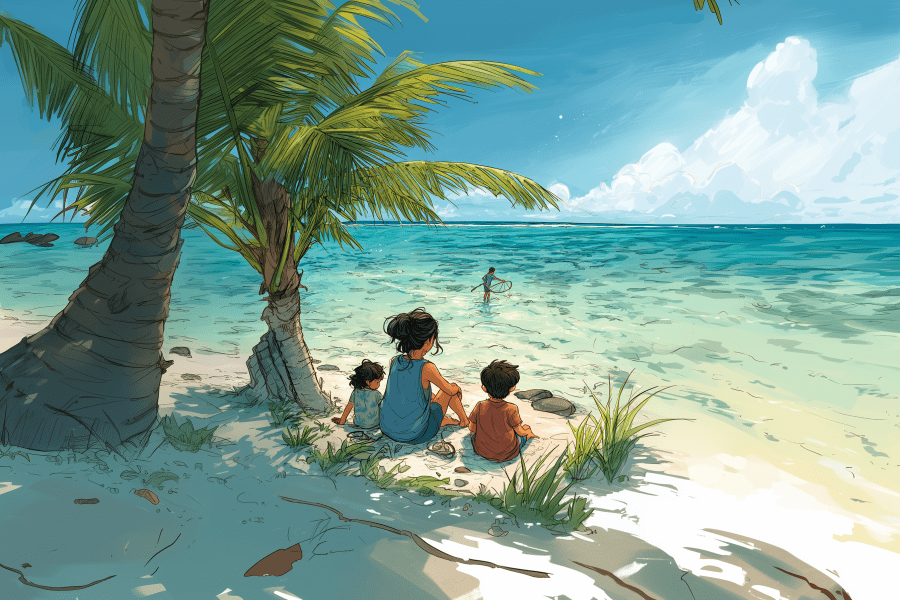
This week’s story will turn back to the topics of food and where it comes from, specifically a particular fish that’s well loved by Chamorros. In this short piece, we’ll be reading about a slice of life from a family of four as they prepare at home and venture out together to catch mañåhak, the young rabbitfish. These tiny fish travel in large schools, usually presenting a great prize for the individuals and communities that pour their efforts into catching them. In this post we have the Chamorro text, an English translation, and a Chamorro audio narration by Jay Che’le. Happy reading!
Talåyan Mañåhak
Tinige’ as Jesus C. Barcinas
Pinenta as Ricardo T. Jesus
Si Pepito ha li’e’ si tatå-ña na matåtå’chong ya kalan manlålåkse. “Para håfa enao, Tåta?” ha faisen si tatå-ña.
Ineppe si Pepito as Tåta, “Hu arérekla este i talåya sa’ para in émañåhak yan si nanå-mu agupa’. Malago’ hao un dalalak ham?”
“Hunggan, Tåta. Bai fangonne’ lokkue’ manådan guihan,” manoppe si Pepito, ya sumén magof.
“Hånao faisen si Carmen che’lu-mu kao malago’ sumaonao,” ilek-ña ta’lo si Tåta. “Ya falak i kusina ya un atan kao guaha guihi båtde yan kostat kaban.”
“Para håfa, Tåta?” ilek-ña si Pepito.
Chumålek si Tåta ya ha ñangon si Pepito. “Siempre gof meggai na mañåhak ta konne’. Ta nisisita mandånkolo na sahguan.”
Ensigidas malågu si Pepito para i kusina. Ti apmam måtto ta’lo tåtte gi as Tatå-ña. “Hunggan, Tåta, guaha båtde yan kostat kaban gi kusina,” ilek-ña si Pepito.
Malågu si Pepito guatu gi hatdin, umå’ågang, “Nåna! Carmen! En tingo’ håfa? En tingo’?”
“Håfa, Pepito? Håfa na’ gof magof hao?” finaisen as Nåna.
Chaddek si Pepito manoppe, “Sa’ para ta fanémañåhak agupa’. Malago’ hao, Carmen, sumaonao?”
Mansén magof i tres ya manhånao tåtte gi gima’. Chumålek si Pepito ya ha sangåni i dos, “Para ta na’bula un båtde yan un kostat. Esta listo todu i sahguan. Para u talåya si Tåta, ya siempre meggai mañahåk-ta.”
I sigiente dia tåftaf manhånao i familia para i tasi. Ma li’e’ na guaha esta siha taotao ni’ mas manaftaf ki siha.
“Atan, Tåta!” umessalao si Pepito ya esta tumáta’yok, “Atan sa’ esta manmangonne’ ayu huyong siha na taotao. Esta bula i kestat-ñiha!”
Ñinangon si Pepito as tatå-ña, “Påkaka’ fan, ihu, sa un espånta i mañåhak.”
Lao sigi ha’ si Pepito bumuruka. Tinago’ as Tatå-ña, “Falak ayu hålom, ya un såga gi papa’ tronkon niyok. Siempre bai ågang hao yanggen mangonne’ yu’.”
Si Carmen lokkue’ umessalao, “Ayugue’ i mañåhak! Mampayaya’ya! Yotte, Tåta.”
“Påkaka’, Carmen. Ti mañåhak un líli’e’. Aguas yan giñu ayu siha. Falak hålom lokkue’, ya un såga gi papa’ tronkon niyok,” tinago’ si Carmen as Tatå-ña.
La åpmam gi papa’ tronkon niyok si Carmen, si Pepito, yan si nanan-ñiha. Eståba ha’ si Tåta gi kanton unai.
Finaisen i dos patgon as Nåna, “Ti mama’ho hamyo na dos?”
Si Pepito manoppe fine’nana, “Åhe’, Nåna, ti mama’ho yu’, lao esta yu’ o’son. Ya hågu, Carmen, ti o’o’son hao?”
“Hunggan, Pepito, esta o’son yu’,” ilek-ña si Carmen. Pues ha sangåni si nanå-ña, “Ñålang yu’, Nåna. I mohon1 ya guaha inafliton mañåhak, bai láchachai ha’.” Kanna’ tumåtånges esta si Carmen.
Si Nåna ha pasensiayi i famagu’on. Ya ilek-ña, “Siempre u fangonne’ si tatan-miyu. Gof maolek talayå-ña. Siempre u fangonne’.”
“Lao esta åpmam ya tataya’ ha’ hina-ña2,” ilek-ña ta’lo si Carmen.
Ti åpmam mahungok si Tåta na umé’essalao, “Ana! Carmen, Pepito! Enague’ mågi3 un katdumen mañåhak! Dånkolo na katdumi! På’go na mannahong hit.4“
Ha tutuhon manmalågu guatu gi as Tåta, lao mantinago’, “Nangga ha’ guenao estaki hu yute’ i talåya.”
“Ai, che’lu-hu Pedro5,” ume’kahat si Nana, “na’siguru na un konne’.”
Manhasso ta’lo si Nåna, “På’go na bai fanåsne ya bai paksio6 mañåhak, ya si Carmen u fanaflitu.”
“Fañigi mågi sa’ dinanche i katdumi. Baba i kestat, Pepito. Na’listo i båtde, Carmen,” inalula si Tåta sa’ pot no u diningu ni’ mañåhak.
Chaddek lokkue’ si Pepito ilek-ña, “Esta. Esta todu listo! Håtsa i talåya, Tåta!”
Gof magof si Tåta annai ha oppe si Pepito, “Esta, lahi-hu, bai håtsa. Maila’ i båtde7.”
“Ai, afanadai8! Dos ha’ na mañåhak hina-ta,” ti gof magof kumuentos si Tåta.
Mamatkíkilu ha’ i dos patgon. Ilek-ña si Nåna annai lá’apmam, “Håfa adai, Pedro9, na’ dos ha’ na lesso’ kinenne-mu? Guaha mit yan mit na mañåhak manhålom gi talåya. Manmangge siha?”
“Buente adai, Ana, båstos dimasiao i talåya, ya dos ha’ na lesso’ gi katdumi. Manmalågu i ha’tang sa’ manggof dikike’.” Este ha’ siña ha sångan si Tåta pot i mañåhak. Pues ilek-ña ta’lo, “Cha’-miyu fano’o’son, ya ta nangga otro katdumi. Sísiña ha’ manmangonne’ hit.”
O’son i nana ya ilek-ña guatu gi tata, “Båsta adai, Pedro10. Munga hit muna’fanñålang i famagu’on pot i taya’ mañåhak. Gof meggai na nenkånno’ guaha giya hita. Båsta, ya nihi ta fanhånao.”
Gof malago’ i dos påtgon na u fangonne’ mañåhak si tåtan-ñiha. Manhasso si Pepito, ya ilek-ña, “Tåta, guaha dos na talåyan mañåhak gi as Tan Anan Juan. Ya gaige si Tun Juan giya Saipan. Nihi ya ta ayao unu gi talåyan-ñiha.”
“Maolek hao manhasso, Pepito,” ineppe as tatå-ña. “Pues nihi. Dalai ya ti ta fansuette agupa11.”
Throw Net for Rabbitfish
Written by Jesus C. Barcinas
Illustrated by Ricardo T. Jesus
Pepito saw that his father was sitting down and it was as though he was sewing something. “What is that for, Father?” he asked his father.
Pepito was answered by the dad, “I am preparing this, the throw net for rabbitfish because we will fish for baby rabbitfish with your mother tomorrow. Do you want to come with us?”
“Yes, Father. I will also catch lots of fish,” Pepito answered, and he was so happy.
“Go ask your sister Carmen if she wants to join,” Father said again. “And go to the kitchen and look if there is a bucket and a (one hundred pount) sack there.”
“What for, Father?” Pepito said.
Father laughed and he whispered to Pepito, “There will definitely be a great many baby rabbitfish we will catch. We need some big containers.”
Pepito quickly ran to the kitchen. Soon he arrived back to his father. “Yes, Father, there is a bucket and a (one hundred pound) sack in the kitchen,” Pepito said.
Pepito ran to the garden, calling out, “Mother! Carmen! Do you know what? Do you know?”
“What, Pepito? What has made you so happy?” he was asked by Mother.
Pepito quickly answered, “Because we will be fishing for baby rabbitfish tomorrow. Do you want to join, Carmen?”
The three were very happy and went back to the house. Pepito laughed and told the two of them, “We will fill a bucket and a (one hundred pound) sack. All of the containers are already ready. Father will catch fish with the fishing net, and we will definitely have a lot of baby rabbitfish.”
The following day the family went early to the ocean. The saw that there were already people who were earlier than them.
“Look, Father!” Pepito shouted and he was already jumping, “Look because those people out there have already caught something. Their sacks are already full!”
Pepito was whispered to by his father, “Please be quiet, son, because you will scare away the baby rabbitfish.”
But Pepito kept making noise. He was tasked by his father, “Go in over there, and stay underneath the coconut tree. I will definitely call you when I’ve caught something.”
Carmen also shouted, “There is the baby rabbitfish! They are gliding! Throw it, Father.”
“Be quiet, Carmen. It’s not baby rabbitfish you are seeing. Those are baby mullet and silversides. Go in too, and stay underneath the coconut tree,” Carmen was ordered by her father.
Carmen, Pepito and their mother were underneath the coconut tree for a while. Father was still at the shore.
The two children were asked by mother, “Are the two of you not thirsty?”
Pepito answered first, “No, mother, I am not thirsty, but I’m already bored. And you, Carmen, are you not bored?”
“Yes, Pepito, I am already bored,” Carmen said. Then she told her mother, “I’m hungry, mother. Gee, if only there were fried baby rabbitfish, I’d just finish it.” It was as though Carmen was already crying.
Mother was patient with the children. And she said, “Your father will surely catch something. His fishing net is very good. He will definitely catch something.”
“But it has already been a while and he still hasn’t caught anything,” Carmen said again.
Soon Father was heard shouting, “Ana! Carmen! Pepito! There comes a great number of rabbitfish! A big school! Now we’ll be satisfied.”
They started to run over to Father, but they were instructed, “Just wait there until I throw the net.”
“Oh my dear Pedro,” Mother went slowly/carefully, “Make sure that you catch it.”
Mother thought again, “Now I will salt some and cook baby rabbitfish with vinegar and salt, and Carmen will fry some.”
“Come here because the school was netted. Open the sack, Pepito. Get the bucket ready, Carmen,” Father hurried so that the baby rabbitfish wouldn’t get away from him.
Pepito was also quick to say, “Already. Everything is already ready! Lift up the net, Father!”
“Father was very happy when he answered Pepito,” Alright my son, I will lift it up. Bring the bucket.”
“Oh, what on earth is that?!? We only caught two baby rabbitfish,” Father spoke unhappily.
The two children were just silent. Mother said when it had been a while, “What the heck, Pedro, that you caught only two (older) rabbitfish? There are thousands and thousands of baby rabbitfish that got into the net. Where are they?”
“Maybe, Ana, the net was way too rough (not fine), and there are just two (older) rabbitfish in the school. The small rabbitfish ran (away) because they are very small.” This was all Father could said about the baby rabbitfish. Then he said again, “Don’t be weary, we will wait for another school of fish. We can still catch something.”
The mother was fed up and she said to the father, “Give it up, Pedro. Let’s not make the children hungry because there’s no baby rabbitfish. There is plenty of food at home. Stop, and let’s go.”
The two children really wanted their father to catch some baby rabbitfish. Pepito thought and said, “Father there are two throw nets for rabbitfish at Mrs. Ana’s (of Juan) house. And Mr. Juan is in Saipan. Let’s go and borrow one of their throw nets for rabbitfish.
“You are a good thinker, Pepito,” he was answered by father. “Then let’s go. Gosh, and how could we not be lucky tomorrow.”
NOTES
- i mohon: We can understand this phrase as “Gee, if only…” ↩︎
- hina-ña: This means “his catch.” We found the words hena and mehna/mena in dictionaries from Guam and the CNMI, respectively. Hena referes to a catch from hunting or fishing (like fish or deer), while mehna is defined as “to catch a lot / have luck in hunting or fishing.” ↩︎
- enague’ mågi: there comes ↩︎
- På’go na mannahong hit: “We are enough with what we have” or even “We are set with what we have.” ↩︎
- Ai che’lu-hu Pedro: In this line, the woman is speaking to her husband, Pedro. She calls him che’lu-hu, which literally means “my sibling.” For learners, it may seem unusual—if not confusing—to hear someone refer to their spouse this way. But this is a feature of native Chamorro speech. As Ray Barcinas explained in a lecture to our study group last year, couples may address each other as che’lu-hu as a deeply intimate term of endearment. When you are siblings, you are of each other’s blood. In a Chamorro worldview, to be “of each other’s blood” expresses the closest possible bond between two people. Our English approximation for this expression was “Oh my dear Pedro”, but it fails to carry forward the meaning and cultural significance found in the Chamorro. ↩︎
- paksihu: To cook something (usually fish or pork) with vinegar and salt. ↩︎
- Maila’ i batde: The word “maila’” is often used to mean “come.” But it is also used as a command to bring something here. ↩︎
- afanadai: This is an exclamation, which we think might be a form of håfa na adai or håfa ennao adai. The way this expression is said really carries the meaning, which is along the lines of “What on earth is that??” ↩︎
- Håfa adai Pedro?: This is also an expression, similar to the previous note. Even though håfa adai literally means “hello”, it is also said with an air of exasperation or surprise, almost like, “What the heck?” in English. ↩︎
- båsta adai: We can hear or say this phrase with different tones, which will impact the strength of the meaning. In the context of this story, we’ve chosen to understand it as “That’s enough” or “Give it up.” ↩︎
- Dalai ya ti ta fansuette agupa: “Gosh, and how could we not be lucky tomorrow.” This is an example of a double negative (not a technical term) in Chamorro, where a phrase that appears to be negative is actually used to express its opposite. Rather than literally meaning “we won’t be lucky tomorrow,” the use of dalai at the beginning conveys the opposite: a sense of optimism or expectation that they will be lucky. ↩︎
 Lengguahi-ta