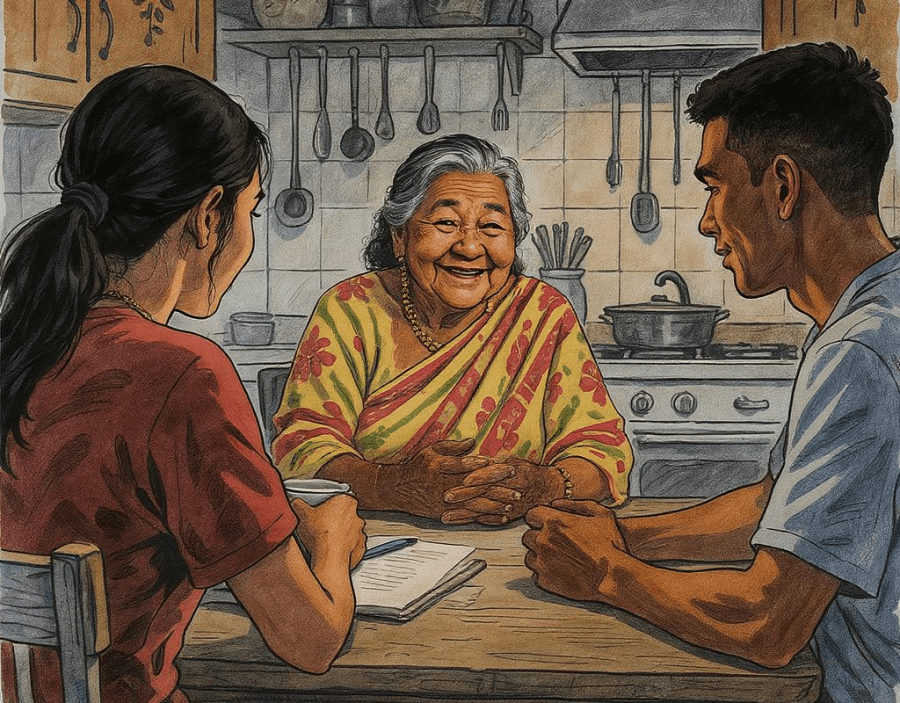
This week, we continue with materials that align to the topics that our practice group wanted to focus on reading. These are selections from Volume 2 of Ginen i Hila’ i Mañaina-ta, the Chamorro Cultural Dictionary publication from the Kumisión i Fino’ CHamoru. The full texts are available through the Commission’s website, but we’ll read today about two common sayings: “Tomorrow is not yours” and “Marry and rest.” You’ll find the Chamorro text and an English translation, along with audio narration from Jay Che’le. Happy reading!
I Agupa’ Ti Agupå’-mu
Rigålu este i lina’la’ para hita. Kumu guiya fuma’tinas hit, gi tiempo-ña na todu manmasusésedi. Hita ni’ manlǻla’la’ gi i prisente, angokko na desde ki i oran manmafañagu-ta esta ta nánangga na siempre u fåtto i oran i finatai-ta. Este ha’ solu na garantiha gi i lumå’la’, i garantiha na un måtai.
Pues, ayu na un cho’gue pågo håfa un magufi para un cho’gue para i familiå-mu, i manatungo’-mu, i kumunidåt-mu, yan kontodu para hågu na maisa. Angokko na gef siña un cho’gue kana’ ha’ todu i dinisihå-mu siha på’go na ha’åni, låo mungnga umangokko para un cho’gue este siha agupa’ sa’ i agupa’ ti agupå’-mu. Håyi u tiningo’ håfa na gotpen sinisedi u guaha gi i tano’, gi i familia, gi i manatungo’-mu, pat i lina’lå’-mu na maisa lokkue’. Siempre u ma tulaika i plinaneha, i håfkao na matiriǻt siha, i ma’usan salåppe’, kareta, guma’, yan bula mås na klåsen tinilaika.
Måolek ha’ para un planuyi håfa para un cho’gue agupa’, låo tungo’ na i agupa’ ti agupå’-mu. Mungnga kumåti, lumalålo’, pat lumayo’ yanggen todu manåtlebes i plinaneha siha sa’ tiempon Yu’os i tiempon Yu’os. Lokkue’, siña ginen matråtan taotao siha ni’ ti ma cho’gue responsapbledåt-ñiha! Låo, gi i minagåhet, guaha ha’ na taotao mumagof sa’ todu mabira pat tumåya’ kinalamten plinaneha.
Ayu na mungnga ma angokko agupa’ sa’ i agupa’ ti agupå’-mu. I ora ti orå-mu. I ha’åni ti iyo-mu ha’åni. Ombres ni’ hågu, ti iyo-mu håo. Tódudu guaha tiempo-ña sigún gi i tiempon Yu’os. Tódudu i nigap-ña siha, i prisente siha, yan i agupa’ yan manmámaila’ siha na tiempo iyon i Saina.
Tomorrow is Not Your Tomorrow
Life is a gift for us. Because he/she made us, it is in his/her time that everything happens. We who are living in the present, expect that from the hour of our birth we are already awaiting the sure arrival of the hour of our death. This is the only guarantee in living, the guarantee that you will die.
And so, that is why you do today what you wish to do for your family, friends, community, and also for yourself. Trust that you really can do just about everything you desire today, but don’t trust that you will do these tomorrow because tomorrow is not yours. Who will know* (who knows) what sudden incident will happen on the land, in the family, with your friends, or also in your own life. Plans will surely change, material things, the use of money, cars, houses and much more types of change.
It’s okay for you to plan what you will do tomorrow, but know that tomorrow is not yours. Don’t cry, get angry, or be disappointed if plans are all reversed, because God’s time is God’s time. Also, it’s possible that people are trusted who don’t do their responsibilities! But in truth, there are still people who become happy because everything turned around or there was no change in plans.
That’s why you shouldn’t depend upon tomorrow, because tomorrow is not yours. The hour is not yours. The day is not yours. Even you, yourself, are not your own. Everything has its time according to God’s time. All the yesterdays, todays, and tomorrows, and the coming times belong to God.
Fanássagua Ya En Fandeskånsa
Esta i dos umáguaiya mama’nú’nu’i na u malågo’ umássagua gi familia ni’ umaguaiyan-ñiha. Tehnga, yanggen guaha fumaisen kåo yan-ñiha esta na para u ássagua, uma’atan i dos na hunggan malago’ para u assagua. “Ai, lahi-hu, ai hagå-hu, pues ássagua ya en deskånsa!” Siempre u ma sangåni i dos. Låo kåo magåhet na u deskånsa i dos yanggen umássagua? Agon? Deskånsa? I palåbras puru ha’ fino’ kado’ sa’ yanggen un gef atan i petsona ni’ umadingángani siha, á’annok na chumålek’ hahallom lokkue’.
Låo kåo håyi guini mohon makékefá’baba? I umássagua na eståo hunggan meggai minannge’-ña: i minames na guinaiya, i dumanña’ gi un såga, i kinalamten susiǻt entre i familia siha yan i púpbleko, i ninanggan famagu’on yan minagof lina’la’ entre i finaloffan i såkkan siha. Låo siguru na masodda’ ni dos umássagua tåftaf pat måchågo’ påpa’ gi kariran-ñiha na makkat i lina’la’ matrimoñu piot yanggen mamífila huyong i famagu’on.1 Ti siña un deskansåyi ni’hǻfafa ha’ yanggen un háhasso put ginen manu mågi i salåppe’ para un apåsi i gima’, un famåhan prubensión nengkanno’, finahan magågu yan sapåtos, finahan nisisidǻt i gima’, inatienden salút i familia, fina’måolek kareta, inapåsen ilektrisidǻt, hånom, opblegasion finatai, fandånggo, bula klåsen silibrasión, yan guaha mås ni che’cho’ eras Yu’os pat hinengang na sinisedi.
Ai hagå-hu! Ai lahi-hu! Magåhet nai “Ássagua ya en Deskånsa!”
Marry and Rest
Two who are in love already show their families that they want to be married through their love of one another. Typically, when someone asks them whether they want to be married, the two will look at each other knowingly, that yes, they want to be married. “Oh son, oh daughter, then marry and rest!” the two will surely be told. But is it true that the two will rest when they are wed? Really? Rest? The words are a complete joke, because if you look closely at the person that’s talking to them, clearly they’re laughing to themself as well.
But who here do they think they are fooling? The state of marriage indeed has many pleasures: the sweetness of love, the unity in one home, the social movements among family and the public, the waiting for children and the joys of life as the years go by. But surely, sooner or later on their path, the two will find that married life is difficult, especially when the children are lining out the door. You can’t rest one bit once you think about where money will come from to pay for the house, to buy food provisions, buying clothes and shoes, buying household necessities, attending to the health of the family, fixing cars, paying for electricity, water, funeral obligations, weddings, all kinds of celebrations, and there are even more things that are the work of natural disasters and unexpected events.
Oh daughter! Oh son! Truly, “Marry and Rest!”
Notes
1 piot yanggen mamífila huyong i famagu’on: This can literally translate to “especially if/when the children are lining up out (the door).” But a speaker in our group told us that this is actually a polite way to say “the babies are dropping, one after the other.” (back to text)
Sources
Kumisión i Fino’ CHamoru. (2024). Ginen i Hila’ i Mañaina-ta: Rinikohen Tiningo’ Yan Sinangan Siha Sigundo na Finakkai: CHamoru Cultural Dictionary: A resource book of significant concepts and sayings (2nd ed., Vol. 2) [PDF]. https://kumisionchamoru.guam.gov/wp-content/uploads/2025/03/Cultural-Dictionary-II_Kumision-I-Fino-CHamoru_Digital.pdf
 Lengguahi-ta