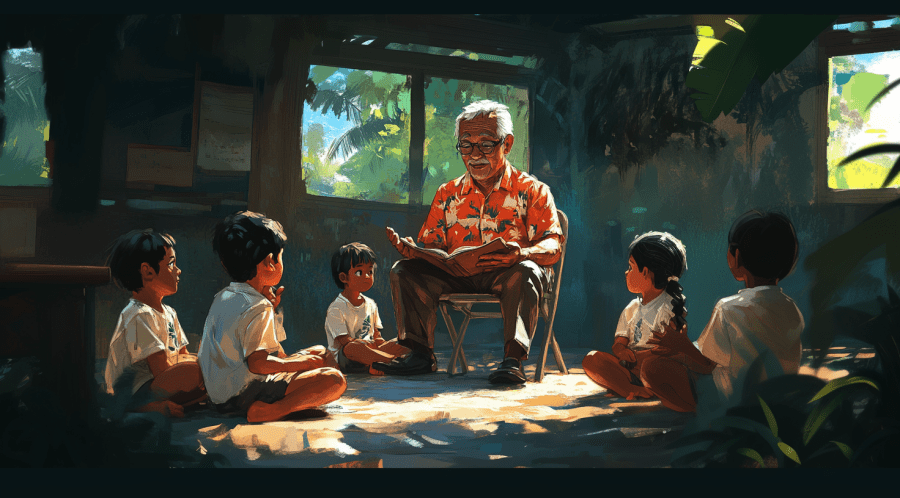
Our practice group recently voted on the kind of content that we’re interested in reading. Two themes came out on top: History and Culture, and this week’s story brings us a bit of both. It’s a short piece from the bilingual education programs of the Northern Marianas that gives a narrative account of Mr. Enrique N. Kisa’s reflections on the past and thoughts on changes he was seeing in the late 1970s. This post includes the Chamorro text, the English translation, and a Chamorro audio narration by Jay Che’le. Happy reading!
Taimanu i Kustumbre Åntes
Tinige’ as Maria Mafnas Rosario
Litråtu ginen as Sylvestre Iguel
Inarekla as Calvin Fujioka
Estague’ si Mr. Enrique N. Kisa. Sumåsaga giya San Roque na songsong. Sisenta åños i idåt-ña.
Si Mr. Kisa (Chamorro), ha tungo’ pot båndan kasamento åntes na tiempo guini giya Marianas. Ilek-ña na åntes na tiempo sen mappot ni para u asagua i dos taotao. I mañaina siha ma sen riktútuyi i hagan-ñiha. Anai måtto ayu na tiempo ni para u ásagua si Mr. Kisa, taiguini finaisen-ña ni palao’an:
“Ti un lalålo’ mohon che’lu-hu ni finatto-ku mågi pot hågu? Para bai hu sangåni hao na i kurason-hu sen mangguaiya nu hågu. Ginen i kurason-hu yo’ sumúsu’on på’go na tiempo yan i kurason-hu yo’ umé’epok ni para bai hu establisa, yo’ guatu giya hågu. Malago’ yo’ na para bai hu sangåni hao håfa siha manggaige gi halom i kurason-hu. Ginen i tinayuyot-hu muna’ hu entrega yo’ mågi giya hågu. Ya malago’ yo’ na para un na’tungo yo’ kao mangguaiya hao nu guahu pat ti mangguaiya hao.”
På’go i palao’an ineppe-ña sigun gi fino’ Mr. Kisa,
“Ti hu háhasso’, enao trabiha. Hanao fan ya bai hu háhasso’ yo’ ya pues ayu na bai hu na’tútungo hao.”
Sigi ha di tumaiguini i fino’-ñiha i dos taotao esta i uttemo-ña umasagua i dos.
Sigun gi hinasson yan tiningo’ Mr. Kisa, i famagu’on åntes na tiempo bula na respetu ma nånå’i i mañainan-niha. I finanå’gue matutuhon desde i gima’. I mañaina siha ma na’ sen takkilo’ i respetu gi gima’. Parehu ha u fañocho, u fanmaigo’, yan u fanhugåndo i famagu’on, manggágaige ha’ i mañaina ni para u ma na’annok ha’ i respeton-ñiha. Lokkue’ yanggen manhåhånao i famagu’on gi chalan ya maná’sodda’ yan i manåmko’ siha, ma go’te i kannai i manåmko’ ya ma nginge’. Bula lokkue’ na bendision i famagu’on ma risísibi ginen i manåmko’ siha. Bunitu i sesteman åntes na tiempo.
I kombetsasión: yanggen i manåmko mankombisasiósion, i famagu’on ti debi di u fanentalo’ gi halom i manåmko’ sa’ ti kombetsasion-ñiha. Sahnge ha’ i kombetsasion-ñiha i mañaina propio, yan i famagu’on lao ti para u fanentalo gi manåmko.
Gi durånten i kombisasión i manåmko, anai mankombetsasión ya uméntalo’ un påtgon, guaha na påtgon ha tungo’ ma señas: anai nina’i señas as nanå-ña esta ha tungo’ ya ha ritira gue sa’ ha tungo’ ha’ na ti debi di u entalo’.
Åntes na tiempo, ma kondúdukta este gi halom i familia: i yanggen para u fañocho i familia, mandanña’ gi lamasa ya manmanaitai. Despues, yanggen monhåyan mañocho, manå’i gråsia si Yu’os pot i nenkånno’-ñiha. Lokkue’ yanggen para u fanmaigo’ yan yanggen para u fanhånao para i che’cho’, manmanaitai todu i tiempo.
Gi båndan rilihón, todu i tiempo i familia mané’etnon ya ma sésen silebra i Damenggo na ha’åni yan i gipot rilihón.
Åntes na tiempo i famagu’on, pat maskeseha håyi na taotao, yanggen para u fanmambisita manmanyåyå’u Buenas Dias (yanggen ogga’an), Buenas Tåtdes (yanggen talo’ani), yan Buenas Noches (yanggen puengi). Yanggen i taotao ni mabisísita ti ilélek-ña na para u hålom, pues ti debi na para u hålom i mambísisita esta ki ha’ på’go masangåni na para u hålom, ayu na u hålom.
Si Mr. Kisa ha akompåra i eskuela åntes yan på’go na tiempo. Ilek-ña na esta gue ocho åños tiempon-ña nai machocho’cho gue gi eskuela, ya ha líli’e ha i famagu’on på’go na tiempo. I famagu’on siha yanggen håfa manmasangångani ni para u fanmakurihi, memeggaiña na biåhi nai ma bira siha tåtte ya masangåni hao ni amko’, pat sinó i ma’estro, båba na palåbra, pat sinó ma atalaki hao, pat sinó ma ila’gue hao.
Ayu ha’ ha gágagao si Mr. Kisa u fanmakurihi i famagu’on mås gi gima’, sa’ ti nahong na para i ma’estro ha’ u ma kurihi i famagu’on gi eskuela, sa’ guaha ha’ palu ma chocho’gue tatkomu i leksión ni manmanånå’i i famagu’on siha. Hunggan, tåya’ ni’ un saina ti kumirírihi i patgon-ña gi gima’, lao yanggen mohon mariktuyi mås i famagu’on gi gima’, siempre didide’ libiånu i kunduktån-ña i patgon gi eskuela. I saina mås gai aturidåt ni para u kurihi i patgon-ña guini gi båndan i respetu. Debi di u ma sangåni i patgon-ñiha na i respetu mås takkilo. Debi di u fanmarespeta i eskuela, i gima’ taotao, yan i chalan.
På’go na tiempo, u fanmaripåra ha’ i famagu’on siha na yanggen humåhånao i amko’ gi chalan dibi i amko’ na u suhåyi i kareta gi chalan sa siempre gue’ machiget. Este siha na sinisedi mampos piligro para mo’na, ya puedi ha’ mohon u ma ekungok si Mr. Kisa i fino’-ña na u ma susteni siha didide’ ya u ma ribåha siha didide’ ya u fanágofli’e unu yan otru sa ayu ha’ nai siña i taotao manágofli’e’ magåhet kabåles ya este ha’ lokkue’ si Mr. Kisa ha gágagao i Saina as Yu’os na u fanágofli’e’ i taotao siha unos yan otros gi todu i tiempon lina’la’.
How Customs Were
Written by Maria Måfnas Rosario
Photographs by Sylvestre Iguel
Layout by Calvin Fujioka
This is Mr. Enrique N. Kisa. He lives in the village of San Roque. He is sixty years old.
Mr. Kisa (Chamorro), knows about the topic of marriage from the past here in the Marianas. He said that in the past, it was very difficult for two people to get married. Parents were very strict with their daughters. When it was time for Mr. Kisa to marry, this is how he asked the woman:
“I hope you aren’t upset, my dear, with my arrival here for you? I’m (here) to tell you that my heart is very in love with you. It’s from my heart that I’m pushed here, now, and my heart has swayed me to establish myself before you. I want to tell you what is in my heart. It’s through my prayers that I’ve brought myself before you. And I want you to let me know whether you love me, or that you don’t.
THen the woman’s answer, according to Mr. Kisa,
“I’m not thinking of that, yet. Go and I’ll think to myself and then that’s when I’ll let you know.”
The pair’s words continued this way until, in the end, they were wed.
According to the memories and knowledge of Mr. Kisa, children in the past gave a lot of respect to their parents. Teaching this began in the home. The parents made respect very important in the home. Whether children were going to eat, going to bed, or going to play, parents were there so that they would show respect. Also, when children would be going down the road and would meet elders, they would take the hand of the elder and pay respect. Children received a lot of blessings from the elders, too. The system of the past is beautiful.
Conversation: when the elders are conversing, the children should not insert themselves among the elders, because it’s not their conversation. The conversation of parents amongst themselves is distinct, and it’s not for the children to become involved with the elders.
While elders are conversing, when there’s a conversation and a child gets involved, there are some children who know to read signs: when they’re given a sign by their mom, they already know and they leave, because they know that they should not be involved.
In the past, this was done amongst the family: when it was time for the family to eat, they gathered at the table and prayed. After, when they were done eating, they gave thanks to God for their food. Also, when it was time for bed or time to go work, they prayed all the time.
On the topic of religion, the family always gathered and thoroughly celebrated Sunday and the religious feasts.
In the past, children, or any person, when they were going to visit someone, they would greet with Good Morning (if it was morning), Good Afternoon (if it was afternoon), and Good Evening (if it was evening). If the person that was being visited did not say to come in, then the visitor shouldn’t come inside until they were told to come in, that’s when they would enter.
Mr. Kisa compared school in the past and now. He said that he’s already spent eight years working at the school, and he sees the children nowadays. Whenever they’re being told something to be corrected, the children more often would turn and tell you, the elder or the teacher, bad words, or they would scowl at you, or they would stick their tongue out at you.
All that Mr. Kisa asks is that children be corrected more at home, because it’s insufficient for the teacher to be the only one correcting children at school, since there are otehr things for them to do, such as the lessons they are giving to the kids. It’s true, there isn’t a single parent who doesn’t correct their child at home, but if only kids were treated a little more strictly at home, surely their behavior at school would be a little smoother. The parent is the one who has more authority to correct their child in the realm of respect. They should tell their child that respect is the most important thing. School, people’s homes, and the road should all be respected.
These days, children can be seen in this way, that if there’s an elder on the road, it’s the elder who needs to avoid the car, on the road because otherwise they’d be run over. Henceforth, hese occurences are very dangerous, and hopefully they will listen to Mr. Kisa’s words that they restrain themselves a little and that they slow themselves a bit and be kind to one another, beacuse that’s the only way that people can truly get along well, and this is all that Mr. Kisa asks of the Lord God, that people will be kind to one another throughout life.
Source
Maria Mafnas-Rosario, “Taimanu I Kustumbre Antes,” University of Guam Digital Archives and Exhibitions, accessed May 17, 2025, https://uogguafak.omeka.net/items/show/593.
 Lengguahi-ta