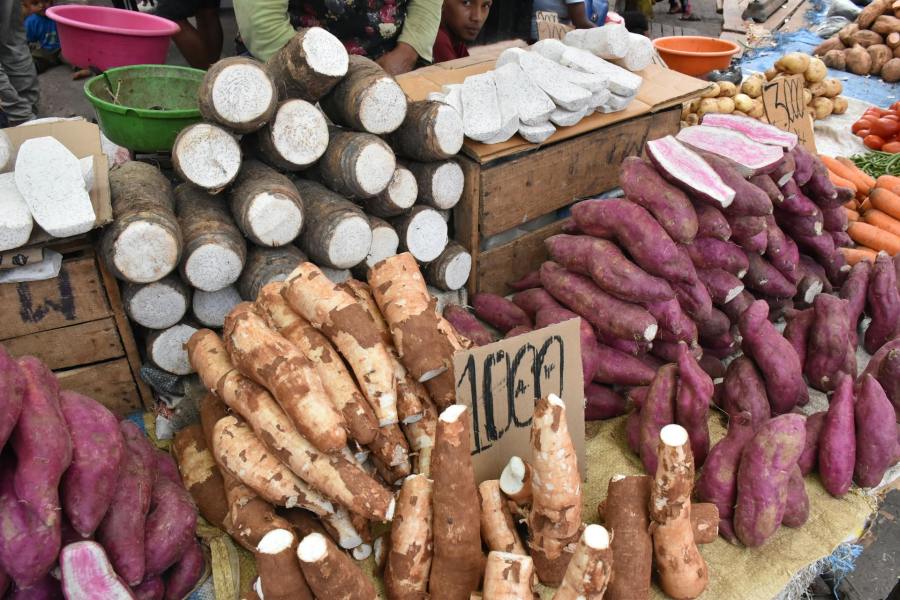
Last Saturday, our group wrapped up Håyi Mansakke’?, a historical fiction piece we read and translated as part of this year’s Mes Chamoru celebration. This week, we’re continuing with a read-through of a Chamorro recipe book by Carmen C. Blas, which I found on the UOG Digital Archives and Exhibitions website. In this post, we’re diving into some traditional Chamorro yam recipes.
Do you recognize any of these dishes? Or are there any you’d like to try for the first time? I’ve had the boñelus dågu and gollai åpan before, but the kåddun o’o’ was completely new to me! This post includes a Chamorro audio narration by Jorell Meno, the Chamorro text, and an English translation. Happy reading!
DÅGU, GADO’ YAN NIKA
I dagu, gado’ yan i nika, unu ha’ na familia. Kumukúnanaf1 este siha na tinanom. Matåtånme yanggen Eneru pat Fibreru para u ginacha’ Noche Buena. Mafa’kostumbre ni Chamorro, na yanggen måtto este na tiempo, enlugåt di håfa na paketi, manå’enñáñaihon2 este i dagu, nika yan i gado’. Guaha bumuñéñelos pues nai ha nå’enñáñaihon. Gof månnge’ lokkue’ makåddon o’o’, pat magollai åpan. Este dipotse na’-ñiha i manChamorro åntes di u fåtto i mai’es yan i pigas Guam. Dumádanña’ este yan i lemmai yan i sini.
BOÑELOS DAGU, GADO’ PAT NIKA
Lassas pues etsis. Nå’yi didide’ ha’ na arina yan didide’ ha’ na hånom. Yanggen malago’ hao na’mames lao meggai ti muna’mámames sa’ para matotche gi atnibat.
Nå’yi hånom i kannai-mu para munga chetton ya un fa’bolabola huyong yanggen un fokse ni kalulot-mu. Na’maipi nåya i laña pues nai un foksiyi. Aflitu asta ki måsa.
KÅDDON O’O’
Gisa i mannok pat kåtne, nå’yi hånom na’falingu ha’ i katne. Lassas i nika, pat gado’ pat dågu ya un nå’yi påpa’ yanggen loklok. Yanggen esta måsa nå’yi didide’ lechen niyok para u nina’paopao. Gof månnge’ masopas i hineksa’ ni kaddo’ pat sinó ma’o’o’. Ayu na mafa’nana’an kåddon o’o’.
GOLLAI ÅPAN
Lassas i dagu, gado’ pat nika. Dibåna ya un na’fanparehu påpa’ gi la’uya. Nå’yi lechen niyok ya un na’lågu asta ki åpan. Adahi na u kimason i fondo. Gof månnge’ manå’yi gollai puntan kalamasa pat friholes yan tasåhos kåtnen babui i sanhilo’ pues nai maleche.
Yams
The greater yams, the wild yams and the lesser yams are just one family. These plants are vines (creeping plants). They are planted when it’s January or February to be ready at Christmas. It was made into a custom by the Chamorros, that when this time arrives, instead of a parcel, this, the yams, are given away. Some people make donuts, and then they give them away. It’s also very delicious if it is made into drinking soup, or if it is boiled in (coconut) milk and reduced. This is supposed to be the food of the Chamorros before corn and rice arrived on Guam. These go together with breadfruit and taro.
Yam Donuts
Peel it then grate it. Add just a little bit of flour and a little bit of water. If you want to, make it sweet, but many (people) do not make it sweet because it will be dunked in syrup.
Add water to your hand so that it won’t stick, and you will form balls if you squeeze it out with your fingers. Heat the oil first, then that’s when you will squeeze it into it (the oil). Fry it until it’s ready.
Drinking Soup
Sauté the chicken or the meat, add water (and put enough) so that the meat just disappears. Peel the lesser yam, or the wild yam or the greater yam and add it down if it’s boiling. If it’s already done, add a little bit of coconut milk so that it will be made fragrant. It’s very delicious if the rice is mixed with the soup, or else it is drunk. That is why it is called “drinking soup.”
Cooked in Reduced Coconut Milk
Peel the greater yam, wild yam, or the lesser yam. Slice it and make it even at the bottom of the cooking pot. Add coconut milk and cook it until it’s reduced. Be careful that the bottom does not burn. It is very delicious if pumpkin tips, or beans and cut pork are added to the top, then coconut milk is added.
Notes
1 kumukúnanaf: This means “crawling, creeping” and in the contexts of plants, it refers to vines.
2 manå’enñáñaihon: This means “are given all away” as in the yams are being given to people for them to keep. The root word is nå’i which means “to give something to someone”. The use of the suffix -ñaihon, and the passive ma- prefix gives it the added meaning of “to give away.” The -ñaihon suffix has several meanings, and in this case, it appears to be used as an intensifier, in the sense of “everything or nothing.”
Source
Carmen C. Blas, “Manmannge’ Na Nengkanno’ I Manchamorro Yan Taimanu Manmafa’tinas-niha,” University of Guam Digital Archives and Exhibitions, accessed January 16, 2025, https://uogguafak.omeka.net/items/show/548.
 Lengguahi-ta