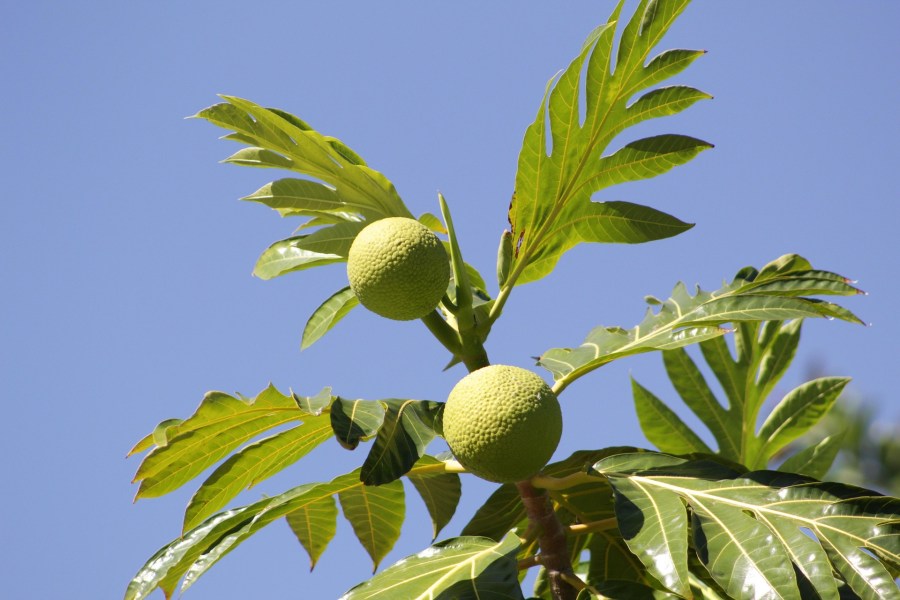
While it’s harder to come by in the Pacific Northwest, breadfruit is an abundant and beloved staple across most of the Pacific and the Marianas are no exception. Breadfruit season on Guam makes for plentiful supply. A few years ago, when we were visiting Guam with my cousin, we were lucky enough to enjoy some breadfruit, which we prepared by blackening in the barbecue coals and smashing open to enjoy with our meal. In this post we will learn more about breadfruit on Guam and read four short recipes for preparing it. This is the fifth part of the book Manmannge’ Na Nengkanno’ I Manchamorro Yan Taimanu Manmafa’tinas-niha written by Carmen C. Blas, which I found in the UOG Archives and Digital Collections website. This post includes the Chamorro text, an English translation, and a Chamorro audio narration by Jay Che’le. Happy reading!
Updated 15-Feb-2025: Added discussion notes from our Saturday morning practice group.
LEMMAI
Este i lemmai na tinanom bula mandódokko’ gi enteru i islan Marianas. Yanggen guaha esta un trongko gi lugåt, utot ha’ i hale’ ya u fañusu sa’ guaha otro trongko. Taiguini ha’ matånméme-ña1 i lemmai.
I tinekcha’ lemmai, yan på’go manhuyong, manggof betde, si mås to’a mås muetto2 i kulot-ña na betde yan mås amariyu. I tinekcha’ yanggen to’a pat mames, makåkånno’ ni Chamorro. Gof håssan esta manbihu na trongkon lemmai sa’ manyinamak ni pakyo. Yanggen humåhånao hao gi katsåda, guaha siha trongkon lemmai gi oriyan guma’ pat i halom tåno’.
Gof bunitu i trongkon lemmai mafa’nuhong3 sa’ gof mayao ramås-ña yan hagón-ña. Mandångkulu hagón-ña ya gof bunitu malapbla-ña. Åntes na tiempo gi tiempon antigu, masångan na mafa’tåtåmpe4 gi tátaotao-ñiha kuentan5 magågu.
GOLLAI ÅPAN LEMMAI
Lassas i te’a na lemmai ya un dibåna na’fanganifes.6 Na’fan parehu påpa’ gi la’uya ya un nå’yi asiga pues leche niyok. Na’lågu asta ki åpan i hanóm-ña. Guahi sa’ måsa. Gof månnge’ manå’yi gollai yan mantikan babui i sanhilo’ i lemmai.
BOÑELOS LEMMAI
Sotne i lemmai asta ki måsa. Låssas ya un yamak pat mulinu sa’ mås chaddek. Usa i mulinon kåtne yanggen guaha. Yanggen monhayan mamulinu pat mayamak, nå’yi didide’ arina yan baking powder, yan lechen niyok para u mås påska. Yilulok ya un fotma taimanu i minalago’-mu. Bunitu ha’ taiguihi i rosketi. Aflitu asta ki mañule’ kulot. Pues guahi sa’ måsa.
ESSOK LEMMAI
Låssas i lemmai pues dibåna na’fanganifes. Na’fan parehu gi pan ya un hotno gi hetnon sanhiyong.7 Munga maguahi asta ki påska. Makåkånno’ este kalan pån tosta.
INAFLITON LEMMAI
Låssas i lemmai pues dibåna na’fanganifes. Na’suha i talo’ ni gai maddok. Aflitu gi laña asta ki tosta. Gof månnge’ matotche gi atnibat.
BREADFRUIT
There is a lot of this plant, the breadfruit, growing in all of the islands of the Marianas. If there is already a tree in a place, just cut the root and it will be nourished to develop into a shoot because there is another tree. Breadfruit is planted just like this.
The breadfruit fruit, when they first emerge, are very green, and if it’s more mature, its color of green is deadened and it is more yellow. The plant, when it is almost ready to be picked or sweet, is eaten by the Chamorros. Old breadfruit trees are very rare because they have been destroyed by the typhoon. If you are going on the road, there are breadfruit trees around the house or the jungle.
The breadfruit tree is very nice to be used as shade because its branches and leaves are very shady. Its leaves are big and its scalloped cut is very pretty. Before, in ancient times, it is said that they were used as coverings for their bodies instead of clothing.
BREADFRUIT IN REDUCED COCONUT MILK
Peel the mature breadfruit and slice it thinly. Make them even at the bottom in the cooking pot and add salt, then coconut milk. Cook until its water is evaporated. Remove it from the heat because it is ready. It is very delicious when vegetables and pig fat is added on top of the breadfruit.
BREADFRUIT DONUTS
Boil the breadfruit until it is done. Peel it and break it into pieces, or grind it because it’s faster. Use the meat grinder if there is one. When it is done being ground or broken into pieces, add a little bit of flour and baking powder, and coconut milk to make it more crunchy. Roll it and form it how you want. It’s beautiful to do it like the rosketi. Fry it until has taken color. Then remove it from the heat because it’s ready.
DRIED BREADFRUIT
Peel the breadfruit then slice it thinly. Make them even in the pan and bake it in the outdoor oven. Don’t remove it from the heat until it’s crisp. This is eaten like pån tosta (Chamorro toasted bread).
FRIED BREADFRUIT
Peel the breadfruit then slice it thinly. Remove the center which has a hole. Fry it in oil until it is toasted. It is very delicious when dipped in syrup.
Notes
1 matånméme-ña: The root word is tånom which means “to plant.” Then the suffix -i is added to become tånme, which is a contraction of tånomi. The word tånme also means “to plant.” Then we add the passive ma- prefix to make it matånme, which is “was planted.” Then the possessive pronoun -ña is added to make matånme-ña which makes it refer to the breadfruit’s planting (the possessive is for the breadfruit). Finally, it is reduplicated to become matånméme-ña, which brings it into a simple present tense, indicating that this is how breadfruit is platned.
( back to story )
2 muetto: Also muettu. This is from Spanish, meaning “died.”
( back to story )
3 mafa’nuhong: The root word is nuhong which means “shade.” When we fa’nuhong something, it means we have used it as shade or treated it as shade. Then the passive ma- is added to the front to make mafa’nuhong, which means “used / treated as shade.”
As another note, the first part of this sentence reads as Gof bunitu i trongkon lemmai mafa’nuhong, and it’s important to know that the bunitu is tied to the word mafa’nuhong, to mean “it’s nice used as shade” rather than saying the breadfruit tree itself is pretty or nice. The addition of the trongkon lemmai in between just makes it clearer that it is the breadfruit tree that’s nice to be used as shade.
( back to story )
4 mafa’tåtåmpe: This means “was treated as coverings” or “was used as coverings.” The root word is tåmpe which means “to cover”, and then the fa- prefix is added to make it fa’tåmpe, to make it mean “was used / treated as a covering.” The passive ma- prefix is then added to make mafa’tåmpe which essentially makes it like the “-ed” in English, so it becomes “used as a covering.” Finally, it is reduplicated to make mafa’tåtåmpe which brings it into a simple present tense. This conveys that it was something that was often or usually done.
( back to story )
5 kuentan: The root word is kuenta, and one of its definitions is “subsitution, alternative, replacement, something in place of or representative of.” The phrase kuentan magågu can then be understood as “a subsititute for clothing” or “a clothing alternative.” We add the “n” at the end of kuenta to make this noun phrase, because kuenta ends with a vowel. See my notes on noun-noun descriptions for more notes on these types of noun phrases.
( back to story )
6 na’fanganifes: The root word is kanifes which means “thin, flimsy, not thick, sheer.” When we add the causative na- in front, it becomes na’kanifes which means “to make thin.” Then the plural fan- prefix is added in front of kanifes to make na’fanganifes, to indicate that we are making many things thin. In the context of the story, we are making many slices of breadfruit thin.
( back to story )
7 hotno gi hetnon sanhiyong: The word hotno or hotnu can be used both as a verb and a noun. It can mean to bake something, and it can also mean oven.
( back to story )
Listan Palåbra
- simas: si mås
- muetto / muettu: 1) dead 2) very short (of a haircut)
- katsåda: a paved road, built with gravel
- mayao / måyao / måhyao: shade tree, tree with many leaves and branches| I trongkun talisai mampus måhyao hagon-ña. The almond tree’s leaves are very shady.
- malåpbla: was cut or chopped in a zigzag shape; was cut unevenly; was cut in a scallop shape
- i te’a / to’a: almost mature (of fruit), ready to be picked
- påska: brittle, easily broken or snapped; 2) crispy, crunchy
- nuhong: shady, shaded, shadowy Kumu i trongku mampus bunitu måhyåo‑ña, pues guaha tåotåo ti måolik ya na’malangu. When a shady tree is very calm and nice, it means there are bad people who will make you sick.
- kuenta: subsitution, alternative, something in place of or representative of
Source
Carmen C. Blas, “Manmannge’ Na Nengkanno’ I Manchamorro Yan Taimanu Manmafa’tinas-niha,” University of Guam Digital Archives and Exhibitions, accessed January 16, 2025, https://uogguafak.omeka.net/items/show/548.
 Lengguahi-ta