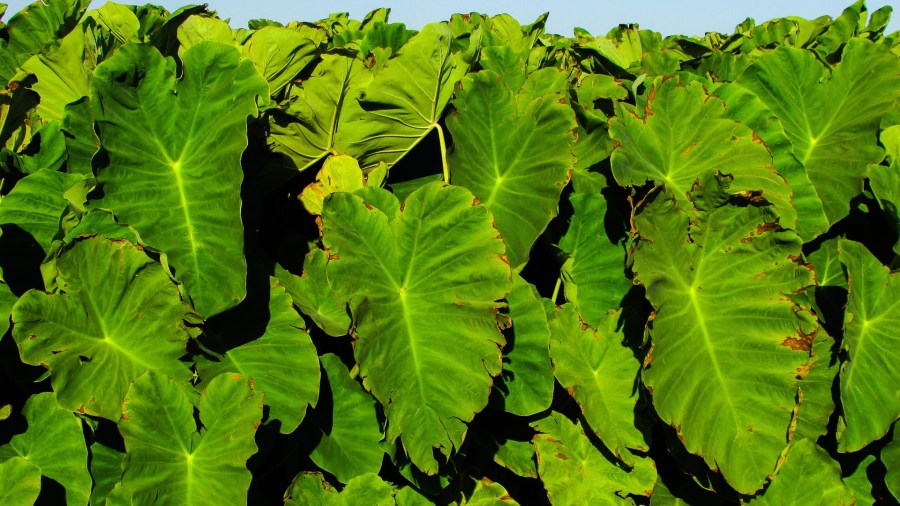
Chamorro recipes that use taro root or taro leaves were rare for me when I was growing up, as they weren’t easy for us to find here in the Pacific Northwest. It was more common for my grandmother to cook with other roots, particulary kamuti (sweet potato), and spinach leaves are a frequent subsitute for the taro leaves when cooking the gollai hagon suni. In this post we will learn more about taro on Guam, and read five short recipes for cooking taro. This is the fourth part of the book Manmannge’ Na Nengkanno’ I Manchamorro Yan Taimanu Manmafa’tinas-niha written by Carmen C. Blas, which I found in the UOG Archives and Digital Collections website. This post includes the Chamorro text, an English translation, and a Chamorro audio narration by Jay Che’le. Happy reading!
Updated Feb-8-2025 with discussion notes from our Saturday morning practice group.
SUNI
Este i sini mafa’å’åggon1 ni manChamorro. Dos klåsen suni guaha Guam. Ayu i sinen agaga’ yan i sinen å’paka ni ma’å’ålok sinen Hawaiian2. I sinen Hawaiian papago’ hagon-ña. I sinen agaga’ makåkånno’ i sensen yan i hagon. Ha gof nisisita hånom este na suni. Ti gof meggai manmanånånom suni sa’ mantinane’ i taotao manhotnot. Siña ha’ este i sini manå’yi i kadon kåtne pat kådon månnok, siña lokkue’ magollai åpan pat masotne ha’. Meggai na suni manhahalom ginen Saipan, Tinian yan Luta.
GOLAI APAN SUNI (TODU I DOS KLÅSEN SUNI)
Sufan i sini ya un ipe’ dos pat ipe’ kuatro segun gi minalago’-mu. Na’parehu påpa’ gi la’uya. Nå’yi asiga pat asukat, månu i ya-mu, pues nå’yi lechen niyok. Sigi ha’ muna’lågu asta ki åpan i lechen niyok. Pulan yanggen esta para u åpan sa’ guaha nai tostos.
LAOLAO SUNI (SUNEN AGAGA’)
Sotne i sini asta ki måsa. Lassas ya un yamak ni tenidot. Kamyuyi3 niyok na’finu ya un na’danña’: Nå’yi asukat para mames. Bolabola ya un na’parehu gi plåtu.
TAMÅLES SUNEN HAWAII
Lassas i sini ya un etses maseha i etses kesu pat i fina’tinas na etses.4 Yanggen munåyan todu un etses, mulinu i månha na’finu. Na’danña’ i minilinon månha yan i inetses-mu suni, pues nå’yi asukat. Gof paopao yanggen mabulatan hagon chotda pues nai mabalutan ni tin foil sa’ nina’pápaopao5 ni hagon chotda. Na’lågu i hanom gi la’uya, didide’ ha’ putnó u chetton gi fondon la’uya. Sigi muna’parehu påpa’ gi la’uya, pues tampe asta ki måsa.
INAFLITON SUNI (HAWAII)
Lassas i sini pues dibåna gi inanako’-ña. Aflitu gi mámamaipi na låña asta ki tosta. Na’tosta månu i minalago’-mu. Yanggen måsa, kalangkångi didide’ asiga pat totche gi atnibat. Parehu ha’ sabot-ña este yan i inafliton batåtas yan i lemmai.
GOLAI HAGON SUNI
Chule’ i bingan hagon suni ya un chankocha. Yanggen esta mañaña’, chuda’ i hanom ya un leche niyok. Nå’yi asiga, lemón yan siboyas ya un na’lågu ta’lo asta ki måsa i lechen niyok.
TARO
This taro is treated as a staple food by the Chamorros. There are two kinds of taro on Guam. They are the red taro and the white taro, which is called Hawaiian taro. The leaf of the Hawaiian taro causes skin rashes. The flesh and leaf of the red taro is eaten. This taro really needs water. Not very many are planting taro because the people are busy laboring. This taro can be added to meat soup, or chicken soup, and it can also be cooked until the liquid evaporates, or just boiled. There is a lot of taro coming in from Saipan, Tinian and Rota.
TARO COOKED IN COCONUT MILK6 (BOTH KINDS OF TARO)
Pare/peel the taro and split it in half, or in fourths, according to what you want. Arrange them evenly at the bottom of the cooking pot. Add salt or sugar, whichever you like, then add the coconut milk. Continue to cook it until the coconut milk evaporates. Watch over it when it is already about to evaporate, because sometimes it burns.
LAU LAU WITH TARO (RED TARO)
Boil the taro until it’s done. Peel it and break it into pieces with a fork. Finely grate the coconut (for the dish) and combine it. Add sugar for sweetness. Form into balls and arrange it evenly on a plate.
HAWAIIAN TARO TAMALE
Peel the taro and grate it with either a cheese grater or a (homemade) grater. When you are finished grating everything, grind the young, green coconut finely. Combine the ground young coconut and your grated taro, then add sugar. It is very fragrant if it is wrapped in a green banana leaf, then when it is wrapped with tin foil, because it is made very fragrant by the green banana leaf. Heat the water in the cooking pot, just a little, so it won’t stick at the bottom of the cooking pot. Continue to make it even at the bottom of the cooking pot, then cover until it is ready.
FRIED TARO (HAWAII)
Peel the taro then slice it lengthwise. Fry it in very hot oil until it is crisp. Make it crisp to how you want. When it is ready, sprinkle a little salt onto it, or dip it in syrup. The flavor of this is just the same as fried potatoes and breadfruit.
TARO LEAVES WITH COCONUT MILK
Take the taro leaf shoot and boil it. When it is already soft, pour out the water and add the coconut milk. Add salt, lemon and onions, and cook it again until the coconut milk is ready.
Notes
1 mafa’å’åggon: The root word is åggon, which means a staple food, or a starchy food. Then it becomes fa’åggon with the fa- prefix, which is interpreted as “to make into” or “to treat as.” So fa’åggon can be understood as “to treat as a staple.” Then it becomes mafa’åggon with the addition of the passive ma- prefix, which we can understand as “was treated as a staple.” Finally, the word is reduplicated to become mafa’å’åggon to make it mean “it is treated as a staple.” The reduplication brings the word into the simple present tense, meaning that this is happens regularly.
You may also be familiar with the word åggon or åggun from the Lord’s Prayer, in the line nå’i ham nu i kada ha’åne na åggon-måmi, which is the Chamorro version of “give us our daily bread”, but is more literally translated as “our daily starch” or “our daily staple.” In the rest of the world, bread is seen as a staple food which sustains people. But in the Mariana Islands, our traditional staple equivalents are not bread, but the starchy foods common to an island such as taro, sweet potato, yam, breadfruit, cassava, and (in our case specifically) rice.
2 sinen Hawaiian: This is a type of taro that is also more commonly known as sunen Honolulu.
3 kamyuyi: The root word is kåmyu or kåmyo, which is used as both a noun and a verb. A kåmyu is a coconut grater, and we can use it to kåmyu the coconut (grate the coconut). In this word, the -yi suffix is attached, which means we are grating the coconut for something, or on behalf of something. In this sentence, we are grating the coconut for the dish.
4 fina’tinas na etses: This literally means “a made grater.” One of our speakers, Aunty Pat, clarified the logic behind this phrase by sharing a story from her childhood. She said that back then, cheese graters (which many of us may have in our kitchens today) were not really sold on the island, or else you didn’t have one. So you would make your own grater, usually by taking an empty, clean sardine can and puncturing holes into it. The punctures would be sharp, and you could use it to grate food. So in the story, the author is telling us that we can use a cheese grater, or else a grater that we make ourselves, in the case that we do not have a cheese grater.
5 nina’pápaopao: The root word here is paopao, which means “fragrant, sweet-smelling.” In general, paopao is used to indicate that something smells good. When we add the causitive na- prefix, it becomes na’paopao, which means “to make fragrant or sweet-smelling.” Then we transform it with the in infix to get to nina’paopao, and in this sentence it allows us to use this verb in a specific word order / syntax which puts more focus on the thing that is being made fragrant. A more complete sentence might be nina’paopao i nengkånno’ ni hagon chotda = the food was made fragrant by the banana leaf. Finally, it is reduplicated to become nina’pápaopao to bring it into a simple present tense, meaning that this is something that happens regularly.
We also talked about the reduplication of paopao. One of the ways we reduplicate words in Chamorro is by repeating the stressed syllable in the word. But when that stressed syllable includes two vowels, such as the ao in paopao, we only repeat the consonant and the first vowel. We do not repeat both vowels, as that creates a little more drag in our mouths, impeding rapid and flowing speech. So we say pápaopao instead of paopaopao.
6 gollai åpan: The dishes marked as gollai åpan are traditionally cooked in coconut milk, and this is reflected in our English translations in this story. The key aspect about any gollai åpan dishes is that the liquid is cooked until it is reduced.
Source
Carmen C. Blas, “Manmannge’ Na Nengkanno’ I Manchamorro Yan Taimanu Manmafa’tinas-niha,” University of Guam Digital Archives and Exhibitions, accessed January 16, 2025, https://uogguafak.omeka.net/items/show/548.
 Lengguahi-ta