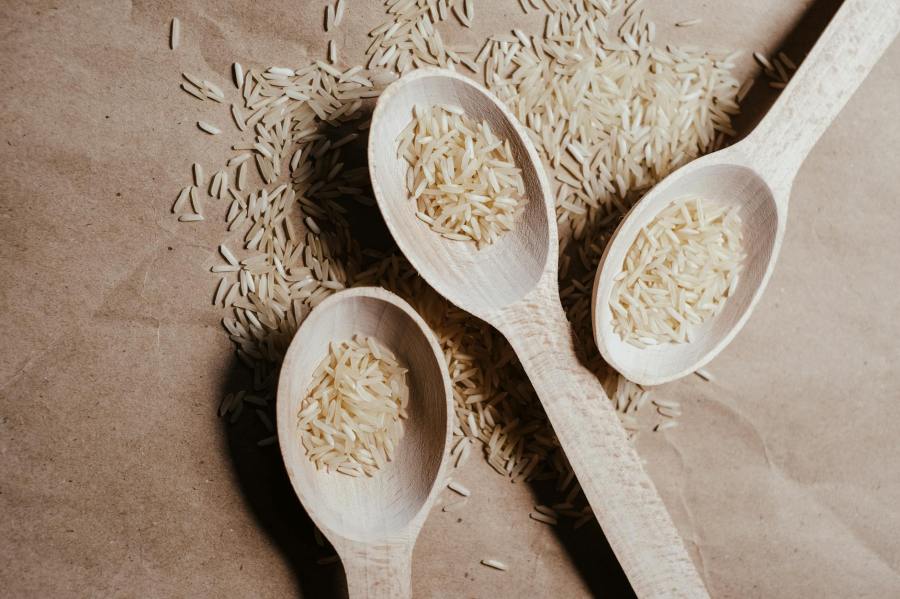
Rice is usually a staple in Chamorro kitchens, both as part of our daily meals and also for special occasions. In this post we will be learning about rice in Chamorro, including three short recipes for making white rice, red rice, and potu, which is a steamed rice cake. These selections are from a book about Chamorro food written by Carmen C. Blas, which I found in the UOG Digital Archives and Exhibitions website. This post includes a Chamorro audio narration by Jay Che’le, the Chamorro text, and an English translation. Happy reading!
(UPDATED 1-18-25: Added explanatory notes from our morning practice group discussion)
PUGAS FA’I
Matåtanom este i fa’i desde i tiempo åntes di si Magellan. Matåtanme guihi siha na lugåt annai fófotgon ha’ todu et tiempo i edda’. Masångan na i manantigu na Chamorro ma koståtati1 ya ma bébende este i pigas gi manmåfatto siha na båtko giya Guam.
Ti siña nahong i nisisidåt i Chamorro ni pigas2 ya manisisita na u mana’fåtto3 ginen Japan, Hongkong, Australia yan California. Este mås takkilo’ na nengkånno’ Chamorro.4 Ti siña manlå’la’ maolek yanggen ti mañocho pugas. Yanggen maná’lagu este i pigas, mafa’nána’an hineksa’.
Gi tiempon gera, mana’fandanña’5 meggai na famalao’an yan lalåhi ni manfáfacho’cho’ ya mana’fanmacho’cho’6 gi fanggualu’an7 få’i. Ma’usa i tano’ desde Asan asta Hågat. Gof meggai na få’i mako’ko’ ginen este siha na fanggualu’an, lao puru ha’ para i Japanese.
Siña ha’ buente meggai matånme ni este i fa’i Guam, lao gof ma’angoku i pigas ginen i otro bånda siha.8
HINEKSA’ Å’PAKA’ YAN AGAGA’
Ma’ú’usa este i pigas para hineksa’.
Hineksa’ Å’paka’
Midi i pigas kuanto na hineksa’ malago’-mu. Kada un tåsa na pugas un tåsa na hånom. Fa’gåsi i pigas asta ki gof klåru i hanom, nå’yi ni hanom ya un ná’lagu, yanggen esta åppan, chågua i guafi asta ki måsa. Yanggen malago’ hao un ná’lagu gi la’uyan hineksa’ (rice cooker), parehu ha’ templådan-ñiha.
Hineksa’ Agaga’
Parehu ha’ este na mididan hånom yan pugas yan i hineksa’ å’paka’.
Nå’yi i la’uya mantika, yanggen esta maipe, nå’yi påpa’ ni siboyas asta ki ginisa. Pues nå’yi ni hanom para kuanto na hineksa’ ya ayu na kantidan hånom para i achoti. Midi lokkue’ i pigas ya un fa’gågasi mientras lóloklok. Yanggen asta lóloklok i hanom i achoti, nå’yi ni pigas. Nangga ya u åppan pues chågua pat ribåha i guafi ya un nangga asta ki måsa.
Potu
Sumai i pigas desde ogga’an asta ki gof måsmai. Mulinu i pigas, yanggen monhåyan un mulinu, liti yan tuba ni gágai ma’aksom. Nå’yi asukat asta ki månu nai ya-mu minames-ña. Po’lo gi na’yan ni taddong sa’ siempre u kahulo’ yanggen bulachu.9 Yanggen asta un li’e’ na kahulo’, lehgua’ ya u poddong. Nangga ta’lo asta ki kahulo’, pues na’listo i la’uya ni para un ná’lagu. Nå’yi i la’uya [ni] alåmle10 ya munga mana’pinacha i potu ni hanom.11 Na’fatå’chong i låttan potu gi hilo’ alåmle ya un tampe. Este i potu manmåsa ha’ gi bente minutos yanggen dikike’ latå-ña.
Uncooked Rice Plant
This rice plant has been planted since the time before Magellan. It is planted in those places where the soil is always wet. It is said that the ancient Chamorros bagged and sold this uncooked rice on the boats that arrived on Guam.
The Chamorro need for rice could not be satisfied, and they needed it to be brought in from Japan, Hongkong, Australia and California. This is the most important Chamorro food. We cannot live well if we do not eat uncooked rice. If this uncooked rice is cooked, it is called cooked rice.
During wartime, many women and men were gathered together who were workers, and they were made to work in the rice farms. The land was used from Asan to Agat. A great many rice plants were harvested from these farms, but it was all only for the Japanese.
A lot of these rice plants could probably be planted on Guam, but the uncooked rice from other places are very much relied upon.
WHITE RICE AND RED
This uncooked rice is used for cooked rice.
White Rice
Measure the uncooked rice to the amount of cooked rice that you want. For every cup of rice, a cup of water. Wash the uncooked rice until the water is very clear, add water to it and cook it, when the liquid is already evaporated, partially reduce the fire until it’s ready. If you want to cook it in a rice cooker, the mixture is still the same.
Red Rice
This measurement of water and uncooked rice is just the same as the white rice.
Add fat to the cooking pot, when it’s already hot, add in the onions until they are sauteed. Then add the water to it according to the amount of cooked rice, and that plentiful amount of water is for the annatto. Measure too the uncooked rice and wash it while the water is boiling. When the water of the annatto is already boiling, add the uncooked rice to it. Wait and the liquid will evaporate, then partially reduce (or turn down) the fire and wait until it’s done.
Rice Cake
Soak the uncooked rice from morning until it is very saturated. Grind the uncooked rice, and when you are finished grinding it, stir it with fermented coconut sap that is already becoming sour. Add the sugar until it is where you like its sweetness. Put it in a dish that is deep because it will definitely rise if it is proving.9 If you already see that it has risen, stir it and it will fall. Wait again until it rises, then prepare the cooking pot that you will cook it in. Add the wire (steamer basket) in the cooking pot and don’t make the rice cakes be touched by the water. Make the rice cake container sit on top of the wire (steamer basket), and cover it. The rice cake is done in twenty minutes if its container is small.
Notes
1 koståtati: The root word is kostat which means “sack” or “bag.” The -i suffix has been added to the end of it to make the word koståti, which means “to bag something” or “to put something into a bag or sack.”
2 Ti siña nahong i nisisidåt i Chamorro ni pigas: The word to pay attention to in this phrase is nahong which means “enough, sufficient, satisfied.” To say that something is ti siña nahong is like saying something was unable to be sufficient, or satisfied. In this phrase, it was the Chamorro need for rice that could not be satisfied.
3 mana’fåtto: The root word is fåtto which means “arrive.” The causitive na- prefix is added in front to make na’fåtto which means “to cause to arrive.” Then the passive ma- prefix is added in front, to make mana’fåtto which means “was made to arrive.” In this context of the text, rice was made to arrive (aka: brought in) on Guam from other places.
4 Este mås takkilo’ na nengkånno’ Chamorro: The word takkilo’ means “high” and comes from the prefix tak- and the word hulo’. The phrase mås takkilo’ literally means “most high” or “highest”, but in this sentence it is used to convey that rice is the most important Chamorro food.
5 mana’fandanña’: This means “was made to gather together” for three or more people. The root word is danña‘ which means “to gather.” The plural fan- prefix is added in front of danña to make fandanña’, which we use with three or more people (in the future tense or commands). When we add the causitive na- prefix we get na’fandanña‘, which is “to make (3 or more people) gather together.” Finally, the passive ma- prefix is added in front of it to get mana’fandanña’, which allows us to remove the person or thing that is causing the gathering. So in the phrase mana’fandanña’ siha, we are saying “They (3+) were made to gather together.”
6 mana’fanmacho’cho’: Similar to note 5 on mana’fandanña, we see a mana’fan- in front of the word macho’cho’ which means “worked.” This is actually a combination of the prefixes ma-, na’-, and plural fan-, which we can understand as “3 or more people were made to _____.” In the word mana’fanmacho’cho’, three or more people were made to work.
7 fanggualu’an: The root word gualo’ has been transformed with the circumfix fan- … -an. This circumfix can be added to nouns or verbs to make a new word that means “the place of _____.” A common example is fañochuyan, which means “a place to eat” and is understood as “a restaurant.” The word fanggualu’an then means “a place of farming” or “a field for planting crops.”
8 gof ma’angoku i pigas ginen i otro bånda siha: The word angoku means “to trust, to depend upon, to rely upon.” We may be most familiar with the meaning of “trust”, but in this context it is used to talk about how rice from other places is really depended upon.
9 sa’ siempre u kahulo’ yanggen bulachu: We may know the word bulåchu to mean “drunk” or “intoxicated.” But in the context of breadmaking, the word bulåchu actually refers to the proofing process. This is when bread dough rests, allowing the yeast to ferment and produce gas which makes the dough rise. While there is no yeast in the potu recipe, the fermented coconut sap and ground rice flour acts as a live culture which helps it rise. Some people may even add baking powder into the potu mixture to help with the proofing process.
10 Nå’yi i la’uya [ni] alåmle: The word alåmle literally means “wire”, but in the context of the recipe it is referring to a wire steaming basket, which is used to cook the potu.
11 munga mana’pinacha i potu ni hanom. The word pacha means “to touch” and it has been transformed with the in infix which means “touched (by something or someone).” The phrase pinacha i potu ni hanom means “the rice cake was touched by the water.” In front of pinacha we see again a mana-, which makes mana’pinacha meaning “was caused to be touched (by something or someone).”
References
Carmen C. Blas, “Manmannge’ Na Nengkanno’ I Manchamorro Yan Taimanu Manmafa’tinas-niha,” University of Guam Digital Archives and Exhibitions, accessed January 16, 2025, https://uogguafak.omeka.net/items/show/548.
 Lengguahi-ta