Kåntan Chamoru: Otro

I am so excited to share this song titled Otro by my friend Dabit Taitingfong! Some of you may know Dabit from his work on @dihan.dabit on Tiktok and Instagram, where he makes videos and mini Chamorro language lessons – entirely in Chamorro! These past few months Dabit has been caught by a music muse, composing song after song in Chamorro – and this is his first release! If you’ve been wanting more original Chamorro music that’s both contemporary and fresh, his songs won’t disappoint. With romantic lyrics and soft vibes, his songs are a welcome addition to my Chamorro music library. This post includes the Chamorro lyrics, an English translation and footnotes to help us understand some of the language usage in the song. Happy listening!

Continue reading “Kåntan Chamoru: Otro”

Estorian Taotaomo’na: The Ones Driven Out

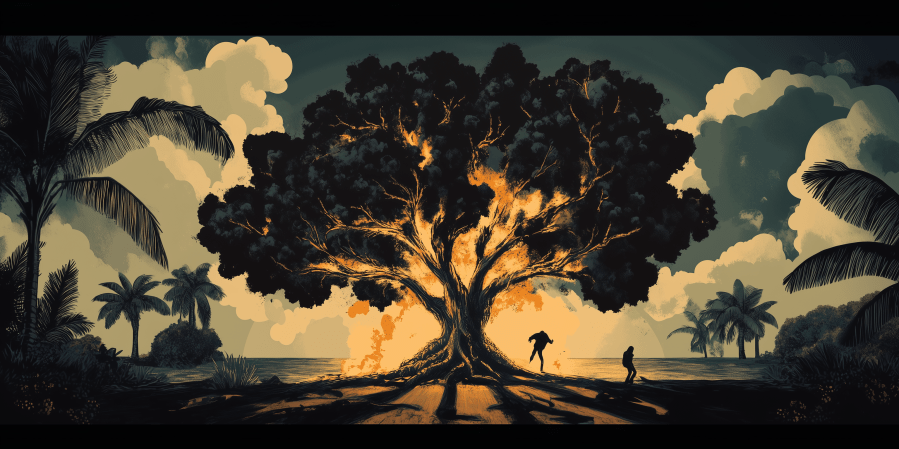
Our story for this Saturday’s practice group is this fantasy short story written by Jay Che’le, edited by Ray Barcinas and friends. In this story, we follow the fictional main character Chå’ as they recount a dramatic encounter with taotaomo’na in Talaifak (a historic Chamorro village on the southen end of modern-day Hågat/Agat on Guam). This story draws inspiration from different encounters with taotaomo’na that happened in Jay’s family in Talaifak over the years, some of which still give everyone goosebumps when they recall them. These encounters range from people suffering a sleepless night, to a dramatic instance when a mango tree was burned to expel the ill-intentioned taotaomo’na (who were in the tree) to the islet of Annai. This explusion of these spirits is why Jay’s mother always told him to never go to Annai.

This post includes the Chamorro text, English translation, and an audio narration in Chamorro by Jay Che’le. Happy reading!


Continue reading “Estorian Taotaomo’na: The Ones Driven Out”

Kåntan Chamoru: Trongkon Niyok

This charming song, Trongkon Niyok, is written and sung by Daniel De Leon Guerrero. Set to the lovely tune of a båtsu (the Chamorro waltz), he sings to us the Chamorro legend of the coconut tree. If you aren’t familiar with the båtsu, it essentially follows the same tempo and step pattern of the Viennese waltz. But what makes it slightly different is that it includes the up and down motion that we find in the “regular” waltz. Our Saturday evening practice group listened to this song a few weeks ago – I’m definitely behind on posting our songs, and I blame the changing weather and migraines! As always, Chamorro lyrics and an English translation are included in this post. Happy listening (and dancing)!

Continue reading “Kåntan Chamoru: Trongkon Niyok”

Estorian Taotaomo’na: The Story of the Fragrant Woman

Another taotaomo’na story this week, from the island of Guam. Set in the village of Agat, this story is about a woman who is accompanied by a strong fragrance and a family who desire to know more about her. There seem to be several stories of the “white lady” or “fragrant woman” spread throughout our islands. Have you heard of a woman like this? This post includes the Chamorro text, English translation, and Chamorro narration by Jay Che’le. Happy reading! (UPDATED 10/14/2024 with discussion notes from our Saturday morning practice group)

Continue reading “Estorian Taotaomo’na: The Story of the Fragrant Woman”

Break Free from Overthinking: 4 Key Study Habits for Natural and Fluid Chamorro Speaking

One of the biggest challenges Chamorro language learners face is speaking naturally and fluidly. Some in our community can understand Chamorro fluently but struggle to form sentences when it’s time to speak. Others grasp the complexities of grammar but freeze up when trying to apply those rules in conversation. Some are conversational, but their Chamorro isn’t as clear or fluid as they’d like. In this post, I’ll share four key study habits that I use to help my speech output become more fluid, natural, and confident. These study habits will be from my perspective as a learner who started from level zero, so please keep that in mind as these study tips may not apply to your learning situation. Happy studying!

Continue reading “Break Free from Overthinking: 4 Key Study Habits for Natural and Fluid Chamorro Speaking”