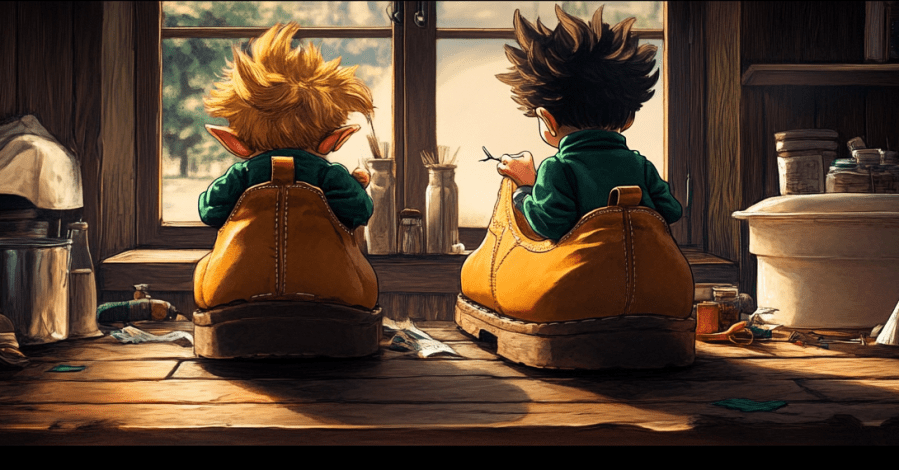
As we head toward Christmas, I thought this cute Christmas-time story would make for some cozy reading. Here is another tale from the Grimm brothers, translated into Chamorro by Rita Inos which I found through the UOG Digital Archive (link to the source is at the bottom of the post). This post includes the Chamorro text, a Chamorro audio narration by Jay Che’le, and an English translation. Happy reading!
I Sapateru Yan I Dos Duendes
Tinige’ nu i chume’lu as Grimm
Pinila’ as Rita Inos
Un tiempo guaha un sapateru ni gof popble. Tåya’ ha’ esta guinahå-ña na didide kueru ha’ anai nahong un påt sapåtos. Ha chåchak i kueru gi puengi kosa ki u låkse gi sigiente diha. Pues anai monhåyan ha chåchak i kueru, ha po’lo tåtte ya humånao para u maigo.
Gi sigiente ogga’an anai kahulo’ gi kamå-ña, manaitai finene’na pues humuyong para u låkse i sapåtos. Gigon tumalakhiyong, ha sodda’ un påt sapåtos gi hilo’ lamasa. Mampos manman i sapateru. Humånao guatu ya ha pacha i påt sapåtos. Todu i linakse manmaolek gi sagan-ñiha. Kulang ha’ mohon fina’tinas i mås maolek na sapateru gi hilo’ tåno’. Ni ti apmam, måtto un taotao para u famåhan sapåtos. Ha chagi gue’ i taotao ya anai maolélek para i addeng-ña, ha apåsi i sapateru yan ha nå’i ha’ mås meggai na salåppe’ pot i guinaiya-ña ni sapatos-ña.
Pues esta i sapateru gai salåppe’. Humånao ya mamåhan ta’lo kueru para dos påt sapåtos. Anai måtto tåtte ha chåchak i kueru ya ha na’listo ta’lo para che’cho’-ña gi sigiente diha.
Anai makmåta ta’lo gi sigiente ogga’an, manman sa’ ha sodda’ huyong ta’lo’ dos påt sapåtos gi hilo’ lamasa. Måtto ta’lo un taotao para u famåhan. Ha sodda’ na gof ya-ña i sapåtos. Ha fåhan ya ha nå’i i sapateru ta’lo mås meggai na salappe’ ki i bålen i sapåtos.
Pues nahong salåppe’ para mås bulan kueru. I sapateru mamåhan ta’lo kueru para bålen kuatro påt sapåtos. Eyu ta’lo na ha’åni, ha chåchak todu i kueru ya ha na’listo gi hilo’ lamasa. Fatta ha’ para u låkse, che’cho’ i sigiente diha i manlåkse.
Anai kahulo’ ta’lo gi sigiente diha, ha sodda ta’lo kuåtro påt sapåtos. Ginen eyu na tiempo, maseha håfa chinachak-ña, siempre gi sigiente ogga’an ha sodda na esta monåhyan. I sapateru på’go na tiempo gof maolek lina’lå’-ña. Esta ti ha siesiente chinatsaga yan ñålang.
Pues un puengi, åntes di u puengen nochebuena, matåta’chong i sapateru yan i asaguå-ña. Esta i sapateru ha chåchak i kueru ni para linakse-ña gi sigiente diha. “Håfa mohon ya ti maigo’ hit na puengi? Malago yo’ na bai hu li’e’ håyi lumålakse i chinachak-hu siha kueru.”
I asagua-ña kontento ni minalago’ i sapateru. Pues humålom ya umatok i dos gi halom kuåtto ya mannangga håyi para u fåtto.
Gigon ha’ tatalo’ puengi, ma li’e dos dikiki’ duendes na humålom. Matå’chong i dos gi hilo’ lamasa ya ma aligao håfa para che’cho-ñiha. Tåya’ ni unu gi dos duendes minagågagu. Anai ma sodda’ i kueru, insigidas ma tutuhon macho’cho i dos. Ai na binibu manlåkse i dikike’ na kannai-ñiha. Anai monhåyan i linaksen-ñiha sapåtos, ma arekla tåtte i kosas siha ya malågu huyong i dos.
Gi sigiente ogga’an, ilek-ña i asaguan i sapateru, “Eyu i dos duendes muna’gofsaga lina’lå’-ta. Debi ta fa’nu’i siha lokkue nu i minagof-ta. Bai hu fa’tinasi siha magågun-ñiha yan sapatos-ñiha.”
Gi anai puengi, esta todu monhåyan i para nina’en-ñiha. Tåya’ kueru mapo’lo gi hilo’ lamasa. Eyu ha’ mapo’lo i nina’en-ñiha i sapateru yan i asagua-ña.
Anai tatalo’ puengi ta’lo, mannugong hålom i dos duendes para u facho’cho. Nina’manman i dos duendes sa’ tåya’ kueru para u malåkse. Pues ma li’e’ i chinina yan i sapåtos. Tuma’yok hulo’ i dos ni minagof-ñiha. Bibu minagågu i dos. Anai monhayan, duru kumånta. Bumaila i dos gi halom guma’, tuma’yok gi hilo’ lamasa yan i siya. Sigi bumaila astaki humuyong i dos gi petta.
Ginen eyu na puengi para mo’na, tåya’ esta nai binisita i sapateru ni dos duendes: Lao i lina’la’-ñiha mås mumaolek. Taya’ esta nai chatsaga i sapateru yan i asagua-ña.
The Shoemaker and the Two Elves
Written by the Brothers Grimm
Translated by Rita Inos
One time there was a shoemaker who was very poor. He already had nothing, except for just a little bit of leather that was enough for one pair of shoes. He cut the leather at night so that he would sew it the following day. Then when he was finished cutting the leather, he put it back and went to go to sleep.
Gi sigiente ogga’an anai kahulo’ gi kamå-ña, manaitai finene’na pues humuyong para u lakse i sapåtos. Gigon tumalakhiyong, ha sodda’ un påt sapåtos gi hilo’ lamasa. Mampos manman i sapateru. Humånao guatu ya ha pacha i påt sapåtos. Todu i linakse manmaolek gi sagan-ñiha. Kulang ha’ mohon fina’tinas i mas maolek na sapateru gi hilo’ tåno’. Ni ti apmam, måtto un taotao para u famåhan sapåtos. Ha chagi gue’ i taotao ya anai maolélek para i addeng-ña, ha apasi i sapateru yan ha na’i ha’ mas meggai na salappe’ pot i guinaiya-ña ni sapatos-ña.
On the following day when he got up from his bed, he prayed first then he went out to sew the shoes. As soon as he faced outward, he found a pair of shoes on top of the table. The shoemaker was very amazed. He went over there and he touched the pair of shoes. All of the sewing was good in its place. It was as though it was the work of the best shoemaker in the world. Not too long after, a person arrived to purchase some shoes. The person tried them, and when they were found to be good for his feet, he paid the shoemaker and he even gave him more money because of his love for his shoes.
Pues esta i sapateru gai salappe. Humånao ya mamåhan ta’lo kueru para dos påt sapåtos. Anai måtto tåtte ha chåchak i kueru ya ha na’listo ta’lo para che’cho’-ña gi sigiente diha.
Then the shoemaker already had money. He went and bought leather again for two pairs of shoes. When he arrived back, he cut the leather and he prepared it for his work on the following day.
Anai makmåta ta’lo gi sigiente ogga’an, manman sa’ ha sodda’ huyong ta’lo’ dos påt sapåtos gi hilo’ lamasa. Måtto ta’lo un taotao para u famåhan. Ha sodda’ na gof ya-ña i sapåtos. Ha fåhan ya ha na’i i sapateru ta’lo mås meggai na salappe’ ki i balen i sapåtos.
When he woke up again on the following morning, he was amazed because he found that two pairs of shoes were already produced on top of the table. Again a person arrived to buy something. He found that he really liked the shoes. He bought it and again he gave the shoemaker more money than the value of the shoes.
And so the money was enough for even more leather. The shoemaker bought leather again, for the worth of four pairs of shoes. That (same) day again, he cut all of the leather and prepared it on top of the table. All that was left was to sew it, sewing was the work of the next day.
When he got up again the following day, he found again four pairs of shoes. From that time, whatever he cut, surely the following morning he would find that it was already finished. The shoemaker now had a very good life. He already didn’t not feel poverty or hunger.
Then one night before Christmas even, the shoemaker and his wife were sitting down. The shoemaker had already cut leather for his sewing on the following day. “What do you think if we don’t sleep tonight? I want to see who is sewing my leather cuttings.”
His wife was content with the shoemaker’s desire. Then the two went inside and hid inside the room and waited for who would arrive.
As soon as it was midnight, they saw two small elves enter. The two sat on top of the table and they searched for what to work on. Not one of the two elves were clothed. When they found the leather, the two instantly started to work. Oh how quickly their small hands sewed! When they were finished sewing the shoes, they arranged the things back and the two ran out.
On the following morning, the wife of the shoemaker said, “Those two elves are the ones who made our live very wealthy. We should also show them our joy. I will make them their clothes and shoes.”
When it was night, the two were already finished with their gives. There was no leather put on top of the table. All that was put was the gifts of the shoemaker and his wife.
When it was midnight again, the two elves rushed in to work. The two elves were made very amazed because there was no leather to sew. Then they saw the shirts and shoes. The two jumped up in their joy. The two quickly got dressed. When they were finished, they continued to sing. The two danced inside the house, they jumped up onto the table and the chairs. The two kept dancing until they went out the door.
From that night until now, the shoemaker was never again visited by the two elves. But their lives became better. The shoemaker and his wife were never poor.
Source
Rita Hocog-Inos, “I Sapateru Yan I Dos Duendes,” University of Guam Digital Archives and Exhibitions, accessed November 25, 2024, https://uogguafak.omeka.net/items/show/512.
 Lengguahi-ta