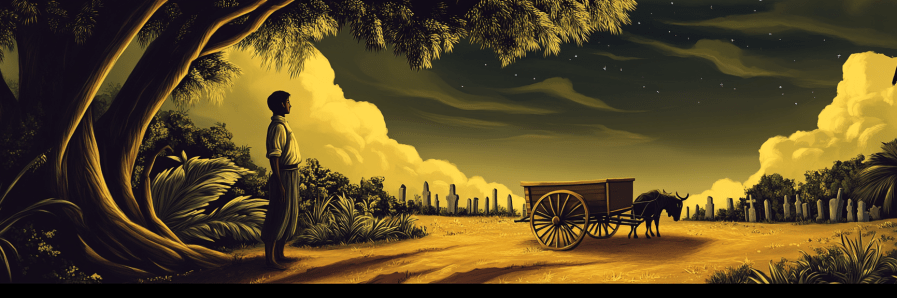
Our Saturday morning practice group will be reading a short story this week. This is a story from the island of Luta, about a cart that is sometimes seen and heard at night. It has some spooky vibes, which is perfect for the end of October. This post includes the Chamorro text, an English translation, and a Chamorro audio narration by Jay Che’le. Happy reading! (Updated 11/2/2024: Added footnotes on select words and phrases to highlight the main discussion points from our practice group session.)
I Karetan Chichekchek
Ginen i “Lepblon Manaitai Para I Sinko Grådu”
Nina’huyong nu i Marianas District Education Media Production
Anakko’ na tiempo, i taotao siha guini giya Luta ma hongge todu i manmasangånen-ñiha1 nu i manåmko’. Put esti na rasón annai malóloffan un puengi esti i taotao gi siudå nai ha susedi esti na sinisedi.
Esti na taotao mampos yayas sa’ ginen i lancho gue’. Pues annai esta para u fåtto gi gimå’-ña ha hungok chichekcheck ginen i simenteyu. Chichekcheck kulang i karetan guaka2. Pues ilek-ña esti i taotao nu guiya, “Dalai3 ya para guaha karetan guaka humåhanao na ora.”
Pues esti i taotao ha nangga esti i kareta gi homhom na lugåt para u li’e’ håyi na taotao humåhanao na ora yan i chekcheck na reda. Maseha ti siña ha li’e’ i kareta, ha húhungok ha’4 i chekcheck. Pues ti humånao i taotao sa’ ha nánangga ha’4 i kareta lao despues maloffan ha’4 lao ti ha tungo’ håyi sa’ ti manli’e’ taotao.
Gi sigenti diha ha sangåni i manamigu-ña put i sinisedi-ña. Guihi ta’lo na puengi, ha nangga i lancheru yan i karetå-ña guaka. Pues ni ti apmam ha li’e’ i karetan guaka, lao tåya’ sumusugon. Ya annai humåhanao esti i taotao para i simenteyu nina’malångu5 ya makonne’ asta i espitåt. Desde ayu manmanhongge i taotao nu i karetan chichekcheck.
The Squeaky Cart
From the “Reading Book for the 5th Grade”
Printed by the Marianas District Education Media Production
For a long time, the people here in Rota believed everything that was told to them by the elders. It’s for this reason that when, one night, this person was passing through the city, that this occurence happened.
This person was very tired because he had come from the ranch. Then when he was going to arrive at his house, he heard a squeaking sound from the cemetary. It was a sqeaking like a cow cart. Then this person said to himself, “Geez, I can’t believe that there is a cow cart going at this hour.”
Then this person waited for this cart in a dark place, to see who was going at that hour with a squeaky wheel. Even though he could not see the cart, he was still hearing the squeaking. Then the person did not leave because he was just waiting for the cart, but after it just passed by, but he didn’t know who it was because he didn’t see anyone.
On the following day, he told his friends about his experience. Again that night, the rancher waited wtih his cow cart. Then not long he saw the cow cart, but there was nobody driving it. And when this person was going to the cemetary, he was made ill and was taken to the hospital. From then, the people believe in the squeaky cart.
Notes
1 manmasangånen-ñiha: “What they were told.” The root word is sångan, which means “to say, to tell.” We get to this word with the following: plural man- prefix + ma- prefix + sångan + -ñiha pronoun. We can use these transformations on other verbs, such as:
- manmanå’en-ñiha = what they were given
- manmafaisen-ñiha = what they were asked
- manmafa’nå’guen-ñiha = what they were taught
( back to story )
2 karetan guaka: “Cow cart.” This is an example of how we describe nouns with other nouns in Chamorro. The descriptor always comes last, which is an opposite order from how we would say this in English. Additionally, if the first word ends in a vowel, then we must add an “n”. Here are other common examples of this structure:
- trongkon niyok = “coconut tree”
- hineksa’ agaga’ = “red rice”
- lepblon Chamoru = “Chamorro book”
Another thing to note about this structure is that we can also do this with adjectives. As language learners coming from English, we often first learn to describe nouns by using the na linker, and to say things like “hot tea” we will often say maipe na chå. But speakers will often switch the order and say chån maipe. When to use one structure over the other depends on what you are trying to say and the context.
( back to story )
3 dalai: “Gosh! Goodness! Geez! What the heck?!” This word is an exclamatory expression, used to convey disbelief when confronted with something that may be too much, too little, or something that’s surprising and unexpected in a negative way.
( back to story )
4 ha’: This is an intensifier that can mean “only, just, still, really.” The way we interpret it can depend on the context of what we are saying. Here are some examples, from the story and from other sources:
- ha húhungok ha’ i chekcheck: “He is still hearing the squeaking.”
- ha nánangga ha’ i kareta: “He was just waiting for the cart.”
- maloffan ha’: “It just passed by”
- chumochocho ha’ yu’: “I am still eating”
- Malago’ ha’ yu’ mannangga, lao håfa yu’ bai cho’gue an ti un bira hao?: “I do want to wait, but what will I do if you don’t come back?”
( back to story )
5 nina’malångu: “Was made to become sick.” The root word is malångu, which is often used as a descriptor. We then add the na- prefix, to get na’malångu which means “to make sick/to cause to become sick.” Then we transform it again with the -in- infix to get nina’malångu. In this form, it gives us more options for expressing the idea of the man being made ill. We may be more familiar with this form if it has the object and subject stated, such as in the following sentences:
- Nina’malångu i taotao nu i taotaomo’na = The person was made ill by the ancestral spirit
- Nina’malångu i taotao nu i sirenu = The person was made ill by the cool, nighttime air
- Nina’malångu i taotao nu i asu = The person was made ill by the smoke
When we see words in this structure, sometimes the object or subject may be dropped because it’s understood from context. We see that happen in this story with the way they use nina’malångu.
( back to story )
References
Lepblon manaitai para i Sinko gradu. Commonwealth of the Northern Mariana Islands ROTA Project. 1976. Mariana Islands : Mariana District Education Media Production.
oai:pacific.library.manoa.hawaii.edu:547387
 Lengguahi-ta