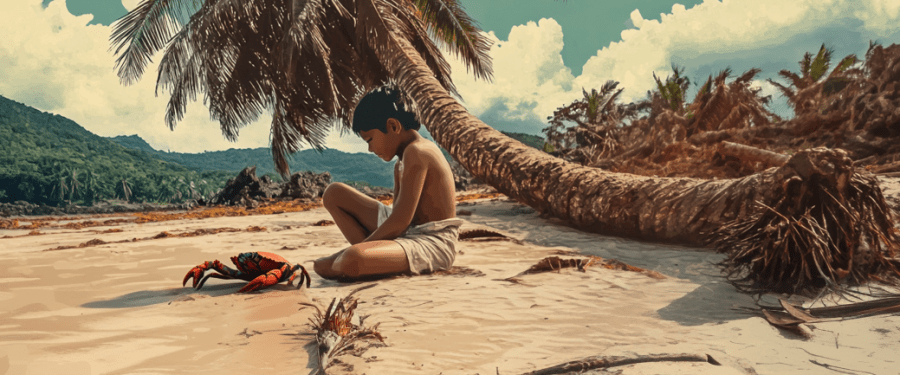
Here is another story about Taga, and this time it focuses more on his family relationships. We learn more about his youngest son, and also one of his daughters. This came from a book entirely about Taga, which we found in the UH Manōa Pacific Languages collection. In this post you’ll find a Chamorro audio narration of the story by Jay Che’le, the Chamorro text, and an English translation. Happy reading!
I Mås Påtgon na Låhen Taga
Tinige’ as Frances Baker
Pinila’ as Sylvestre Iguel
I mås påtgon na låhen Taga sinko åños idåt-ña. Nina’gof banidosu si Taga nu este na patgon-ña. Gof metgot lokkue’ este na påtgon.
Un diha, humånao i patgon umo’mak. Mangonne’ panglao. “Godde fan este i ga’-hu panglao, tata. Ya-hu na panglao.”
Pues si Taga magåhet ha godde i panglao nu i hilu. Pues ha konne’ i patgon guatu i panglao gi gima’ para hugåndo-ña.
Chumålek si Taga annai ha li’e’ i patgon-ña humugågåndo yan i panglao.
Humålom si Taga gi gimå’-ña. Ti apmam ha hungok i lahi-ña manå’å’gang.
“Tåta, maila’ fan ya un ayuda yu’!”
Pues manatan huyong si Taga.
“Atan ha’, maktos i hilu ya malågu i ga’-hu panglao hålom gi papa’ ayu na tronko. Maila’ fan ya un tomba i trongko ya bai hu konne’ i ga’-hu panglao,” ilek-ña i lahi-ña.
“Ti siña,” manoppe si Taga. “Hu tånom enao na trongkon niyok, på’go ha tutuhon gumaitinekcha’. Ti ya-hu tumomba. Hånao ya un fanaligao otro panglao.”
“Mungnga yu’!” manoppe i patgon. “Estague’ i malago’-hu!”
Pues ha go’te i trongko ya ha bokbok pues ha konne’ i ga’-ña panglao.
Nina’sen manman si Taga put esti. Ha tungo’ ha’ na esti na påtgon siempre metgot-ña ha’ ki håyi na låhi.
Nina’ma’å’ñao lokkue’ put esti.
Malågu huyong ginen i gima’, ya ha go’te i lahi-ña pues ha puno’.
“Håfa på’go bai hu cho’gue?” kumåti si Taga. “Siña ha’, ha puno’ yu’ un diha.”
Todudu i taotao nina’fanma’å’ñao as Taga ya ma’ó’osge todu i tinago’-ña.
Lao si Taga tåya’ esta minagof-ña.
I asagua-ña esta trítriste ha’ lokkue’. Nina’gof malångu i palao’an ni triste-ña ya ti apmam na tiempo, måtai.
Muma’å’ñao i bunita na hagan Taga, ya nina’gof lalålo’ lokkue’.
Esta måtai i mås påtgon na che’lu-ña yan si nanå-ña.
Guaha dos na estoria put håfa taimanu masusedi.
I un estoria taiguini:
I bunita na hagan Taga, malågu para i sabåna ya umattok. Pues ti apmam na tiempo, måtai. I animås-ña ha bira gue’ tåtte gi gima’ tatå-ña, ya esta på’go na tiempo guaha na biahi nai mali’e’ guihi.
I otro na estoria taiguini:
I hagan Taga esta muma’å’ñao ya esta ha disiden maisa gue’ na debi di u puno’ si tatå-ña.
Ha sodda’ i lansa ya ha puno’ si tatå-ña gi maigo’-ña.
Pues ti apmam na tiempo måtai gue’. Lao i animås-ña ti siña dumeskåkånsa. Debi di u apåsi i ha puno’ tatå-ña. Ti siña lokkue’ ha dingu i gima’ tatå-ña asta ki poddong i uttimo na åcho’ latte’.
I taotao Tinian ma líli’e’ ha’ i animås-ña. Ya guaha na biahi nai lumålahu ya kumåkåti gi sengsong an puengi.
Taga’s Youngest Son
Written by Frances Baker
Translated by Sylvestre Iguel
Taga’s youngest son was five years old. Taga was made to be so proud by his child. This child was also very strong.
One day, the child went to swim. He caught a crab. “Please tie my crab, father. I like the crab.”
Then Taga really tied the crab with the string. Then the child took the crab to the house for his plaything.
Taga laughed when he saw his child playing with the crab.
Taga went inside his house. Soon he heard his son calling.
“Dad, please come and help me!”
Then Taga looked out.
“Just look, the string snapped and my pet crab ran in underneath that tree. Please come and topple over the tree and I will catch my crab,” his son said.
“I can’t,” Taga answered. “I planted that coconut tree, and now it’s starting to bear fruit. I don’t want to knock it down. Go and search for another crab.”
“I don’t want that!” the child answered. “This is what I want!”
Then he grasped the trunk and he uprooted it, then he caught his pet crab.
Taga was made to be very amazed by this. He knew that this child would definitely be stronger than any man.
He was also made afraid because of this.
He ran out from the house, then he grasped his son, then he killed him.
“Now what will I do?” Taga cried. “He could have killed me one day.”
But Taga already had no joy.
All of the people were made afraid by Taga, and they were obeying all of his commands.
His wife was already very sad. The woman was made very ill by her sadness, and she soon died.
Taga’s beautiful daughter became afraid, and she was also made very angry.
Her youngest sibling and her mother had already died.
There are two stories about what transpired.
One story goes like this:
Taga’s beautiful daughter ran to the mountain and hid. Then after a short time, she died. Her spirit turned back to her father’s house, and until current times, sometimes she is seen there.
The other story goes like this:
Taga’s daughter had become afraid and she had already decided to herself that she must kill her father.
She found a spear and she killed her father in his sleep.
Then a short time after, she died. But her spirit could not rest. She must pay for killing her father. She also cannot leave her father’s house until the last latte stone falls.
The people of Tinian still see her spirit. And sometimes when she is walking and crying in the village when it is night.
References
Baker, F. (1975). Si taga i metgot (S. Iguel, Trans.). Media Production, Marianas District Dept. of Education.
 Lengguahi-ta