Continuing our theme of reading stories from other Pacific Islands, here is a story from Palau that was translated by Dolores Marciano that we found in the Pacific Languages Collection at UH Manoa. This story reminds us that the relationships nurtured between parents and children are more important than superficial concerns. Jay did his best with the pronunciation of the place names from Palau in the story, so our apologies if they aren’t 100% correct! In this post is the Chamorro text, a Chamorro audio narration by Jay Che’le, and an English translation. Happy reading!
I Palao’an Giya Ngerehokl
Sinangan ta’lo as Dolores Marciano
Åntes na tiempo, annai meggai na atte siha manmachócho’gue yan pumusipble, nai masusedi este na estoria giya Belau na isla.
Eståba un palao’an sumåsåga yan i hagå-ña ni gof hoben gi sengsong Ngeredamau. Mampos este i dos sumén popble, sa’ tåya’ siha umaligágague para kinanno’-ñiha. Tåya’ este i palao’an asagua-ña. Mampos i nana ha guaiya i hagå-ña. Ayu mås i minagof yanggen ha líli’e’ i hagå-ña gi fi’on-ña. Gof umágofli’e’ este i dos.
Ha gof pinitiyi i nana i patgon-ña ya sesso ha faisen maisa gue’ håfa para u cho’gue i patgon yanggen siakåsu na måtai gue’. Gi annai mafañågu i patgon esta i palao’an gai idåt ya ma’å’ñao na u sen biha ya tåya’ para u sinetbe i hagå-ña ni trabiha gaige na kuatro åños ha’ i idat-ña. Ma’å’ñao lokkue’ na u chinatli’e’ nu i hagå-ña sa’ esta gue’ sen yommok yan sen makalelu nu i binihå-ña. Lao ayu mås malago’-ña i nana i para u hóhoben ha’ mo’na kosa ki u sísiha yan i patgon todu i tiempo.
Ha hungok i palao’an na guaha un såddok gi entalo’ i sengsong annai sumåsåga gue’ yan otro songsong. Este na såddok mafa’nána’an Ngerehokl. Mampos lokkue’ ná’manman este na såddok sa’ enkantao. Yanggen humålom hao guini gi halom este na såddok, siempre gi humuyóng-mu sen bonita hao, hoben yan mås un siente na bråbu i tátaotao-mu.
Sen manhasso i biha, ha konne’ i hagå-ña para u ma espiha este na lugåt. Duru i dos mamokkat hulo’ gi ekso’. “Para månu hit na dos, nåna?” mámaisen i patgon.
Hinasso-ña i palao’an na para u hongang i hagå-ña put håfa para u cho’gue, chumålek ya ilek-ña, “Para i saddok hit, hagå-hu.”
Sigi i dos mo’na mamokkat esta ki måtto gi taddódong gi halom tåno’. Pues måtto i dos gi un lugåt annai manmanónokcha’ meggai siha na flores, parehu ha’ mandikike’ yan mandångkulo’ siha na flores. Mampos este na lugåt sen bunitu; gaige i saddok gi entalo’ i trongkon håyu siha yan i acho’ guini na lugåt. Meggai paluma siha gi uriyå-ña manggúgupu ya mangákanta. I hanom gi halom i saddok mampos klåru yan sen gåsgas. Tumohge i dos ya ma’atan i saddok ni bunitu-ña.
“Nangga yu’ guini hagå-hu sa’ ti apmam yu’ mågi,” ilek-ña i palao’an.
Humånao i patgon guatu esta i acho’ gi fi’on i saddok ya tumohge guihi na lugåt.
Lumi’of i palao’an gi halom såddok, ya duru umo’mak. Annai kumahulo’ ginen i saddok, ha siente na ñálalang i tátaotao-ña, esta ti makalelu i lassas i tátaotao-ña, bumunita i figuran i matå-ña. Mås i palao’an mumatan hoben, kulang mohon un sutterita.
“Kao ya-mu i figurå-hu, hagå-hu?” mámaisen i palao’an.
Iná’atan ha’ nu i patgon ni sikera u chinatge annai ha kuentútusi i hagå-ña.
“Nihi hagå-hu ya ta hånao para i gimå’-ta sa’ esta ti apmam homhom,” ilek-ña ta’lo i palao’an guatu gi patgon.
Ti kumuekuentos i patgon gi sagå-ña. Sigi i palao’an di ha afuetsas i patgon para u dinalak, lao ti kumeke’kalamten i patgon gi sagå-ña. Gi annai para u mantiene i palao’an i patgon umessalao i patgon ya ilek-ña, “Cha-mu yu’ pápacha. Ti nanå-hu hao ya hu nánangga si nana para u fåtto ya u konne’ yo’. Ti hu nisisita hao sa’ ti hagu nanå-hu.”
Esta i patgon sen lalålo’. Ensigidas ha dingu i sagå-ña ya duru malågu gi entalo’ i acho’ siha ya sigi mamatek i dos addeng-ña gi hilo’ i acho’, mientras malålågu duru lokkue’ umessalao, “Ti nanå-hu hao sa’ hoben-ña hao ki si nåna! Si nanå-hu malago’-hu, ti hågu! Nåna! Maila’ ya un konne’ yu’.” Duru i patgon umessalao ta’lo asta ki ha yute’ gue’ påpa’ ya duru kumåti.
Annai ha li’e’ i nana i hagå-ña na esta imperao, ensigidas ha yute’ gue’ hålom gi halom i saddok ya lumi’of ta’lo un biåhi. Ha yute’ gue’ hålom unos kuantos biåhi esta ki måtto tåtte i hagas figurå-ña ta’lo. Humuyong ta’lo umåmko’, yommok, yan mumakalelu i lassas i tátaotao-ña. Pues malågu tåtte ya ha ågang i hagå-ña.
“Estague’ yu’, hagå-hu, estague’ yu’ na måtto!”
Ai i patgon minagof-ña annai ha li’e’ si nanå-ña. I patgon ensigidas malågu guatu gi as nanå-ña ya ha toktok ya ilek-ña, “Hagas ha’ hu nánangga hao.” Umátoktok i dos ya duru mañålek yan manånges ni minagof-ñiha.
Humånao tåtte i dos gi gima’-ñiha, ya humuyong sumén maolek yan sen magof i lina’la’-ñiha.
The Woman in Ngerehokl
Retold by Dolores Marciano
A long time ago, when a great amount of magic was practiced and possible, was when this story happened in Palau.
There was a woman who lived with her daughter who was very young, in the village of Ngeredamau. These two were extremely poor, because there was nobody to hunt their food for them. This woman did not have a spouse. The woman loved her daughter so much. She was happiest when she was seeing her daughter next to her. These two really loved each other.
The mother really felt for her child and she often asked herself what her child would do if she were to die. When the child was born, the woman was already old and she was afraid that she would be very eldery, and that there would be nobody to attend to her daughter, who was not yet even four years of age. She was also afraid that she would be hated by her daughter because she was already very fat and wrinkled from her old age. But what the mother wanted most was to still be young in the times ahead so that she and the child will always be together.
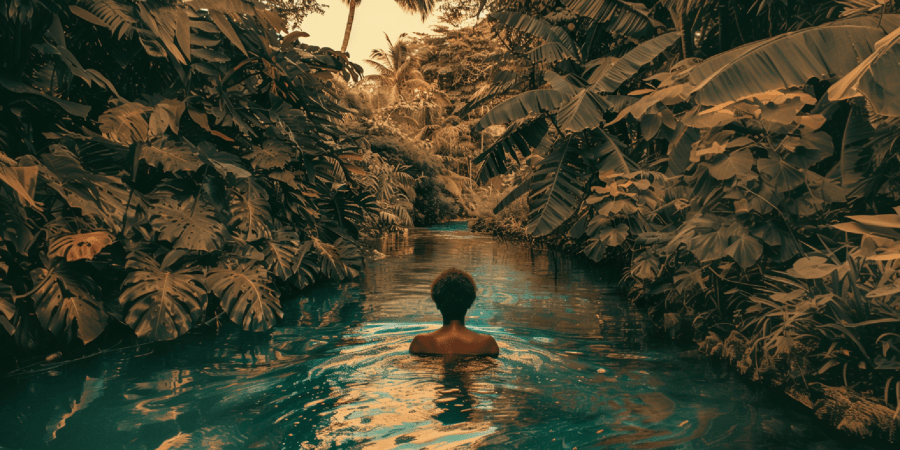
The woman heard that there was a river in-between the village where she lived and another village. This river was called Ngerehokl. This river was also very amazing because it was enchanted. If you went into this river, you would definitely come out to be beautiful, young, and you will feel it more that your body is healthy.
The elderly woman really thought about it, she took her daughter to search for this place. The two kept walking up the hill. “Where are we going, mother?” the child asked.
The woman thought that her daughter would be surprised by what she was going to do, she laughed and said, “We are going to the river, my daughter.”
The two continued to walk on until they arrived in the very deep part of the jungle. Then the two arrived at a place where many flores were sprouting and fruiting, both the small and large flowers. This place was extremely beautiful, the river was between the trees and the rocks in this place. There were many birds around it, flying and singing. The water in the river was very clear and extremely clean. The two stood and they looked at the river in its beauty.
“Wait for me here my daughter because I will come right back,” the woman said.
The child went to the rocks next to the river and stood in that place.
The woman dove into the river, and swam hard. When she got up from the river, she felt that her body was lightweight, the skin of her body was already not wrinkled, and the shape of her face had become beautiful. The woman had come out with a young appearance, as though she were a teenage girl.
“Do you like my form, my daughter?” the woman asked.
She was just looked at by the child, not even was she smiled at when she was talking to her daughter.
“Let’s go my daughter and we will go to our house because it is already going to be dark soon,” the woman said again to the child.
The child was not talking from where she was at. The woman kept trying to force the child to follow, but the child was not trying to move from her place. When the woman was going to hold the child, the child yelled and said, “Don’t touch me. You are not my mother and I am waiting for my mother to arrive and take me. I don’t need you because you are not the one who is my mother.”
This child was already extremely angry. She quickly left her place and kept running amongst the rocks, and she kept kicking up her two feet on top of the rocks; while she was running hard she also shouted, “You are not my mother because you are younger than my mother! It is my mother that I want, not you! Mother! Come and take me.” The child kept shouting again until she threw herself down and cried hard.
When the mother saw her daughter was already agitated, she quickly threw herself into the river and she dove again. She threw herself inside many times until her former shape came back again. She became old again, and fat, and the skin of her body became wrinkled. Then she ran back and she called her daughter.
“Here I am, my daughter, it is me that has come!”
Oh how happy the child was when she saw her mother. The child instantly ran toward her mother and she hugged her and said, “I was waiting for you for a long time.” The two hugged each other and laughed and cried hard in their happiness.
The two went back to their house, and it came to be that their lives were very good and happy.
References
Marciano, D. (1980). I Palao’an Giya Ngerehokl [PDF]. Pacific Area Languages Materials Development Center, Social Sciences Research Institute, University of Hawaii at Manoa.
 Lengguahi-ta