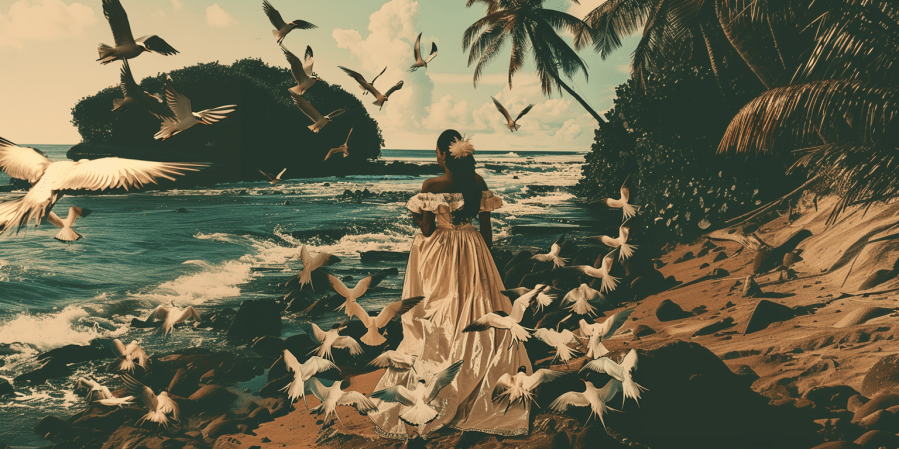
Jay and I are getting settled back into daily life again, after about 4-5 weeks of being away. We put our Saturday practice groups on pause while we were traveling and are excited to be starting them again this week. In honor of FestPac 2024, we will be reading some stories from other Pacific islands throughout the rest of this summer. This story comes from Pohnpei or Ponape, and was translated into Chamorro by Dolores Marciano. We found this in a PDF of Chamorro language stories from the Pacific Languages Collection at UH Manoa, which you can access online! In this post the Chamorro text, a Chamorro audio narration by Jay Che’le, and an English translation are included. Happy reading!
Sakier, I Ná’manman Na Paluma
Sinangan ta’lo as Dolores I. Marciano
Åpmam na tiempo nai masusedi este na estroria giya Ponape. Eståba dos umåsagua yan i dos na hagan-ñiha as Lieni yan si Sakier. Gof umápinitiyi yan umágofli’e’ este i dos chume’lu. Todu i tiempo, sumísiha este i dos chume’lu achok ha’ para u na’gåsgas gi halom i gima’-ñiha pat sino para u fanmama’tinas nengkånno’ pat para u fanmamfok kanastra pat guafak.
Gof bunita yan sen kariñosa si Lieni. Gof anåkko’ i attilong na gapotulu-ña. Kirida si Lieni gi as nanå-ña yan tatå-ña. Maguaiya si Lieni mås ki si Sakier nu i mañainå-ña. Todu i manmångnge’ na nengkånno’ mapópo’lo para si Lieni. Manånå’i si Lieni mås nu i atension kini si Sakier.
Parehu ha’ si Sakier i anåkko’ i gapotulu-ña yan si Lieni, lao magåhet na bunitå-ña ha’ si Lieni kino si Sakier. Mampos umádanche1 kostumbren este i dos chume’lu. Gof kariñosa este as Sakier. Ha tungo’ ha na mås atensíon manånå’i si Lieni nu i mañainan-ñiha, lao tåya’ nai ha na’annok na ti magof gue’ put este na tratamento. Meggai na biåhi nai humånao si Sakier ya mamokkat gi halom tåno’ put para u konsuela i triniste-ña. Lao ni un biåhi nai kumuentos pat ha na’li’e’ i mañainå-ña nu i ti minagof matå-ña.
Un diha, ilek-ña si Lieni as Sakier, “Sakier, maseha un líli’e’ na maguaiya yu’ mås nu i mañainå-ta kini hågu, lao ni guahu ti hu aprueba este na klåsen cho’cho’ sa’ parehu ha’ hit na dos. Chume’lu hit na dos ya todu i tiempo yáya-hu ha’ hao. Ma espípiha empeñu2 as nåna yan tåta para bai hu gofli’e’ siha, lao ti siña sa’ ti parehu i tratamento ni manånå’i yu’ ki hågu.”
Un diha, humånao si Sakier mamokkat gi halom tåno’. Måtto gi un såddok annai meggai siha na åcho’ manggaige gi halom hånom, kulang mohon gua’ot siha gi halom hånom sa’ manggaige todu gi uriya yan i kanton i tano’. Ha li’e’ lokkue’ na guaha siha paluma manggúgupu yan manlilíliko’ gi hilo’ aire. Mansén lamlam i pappan-ñiha ya manggof ma’lak i difirentes na kulot-ñiha. Annai mali’e’ si Sakier nu i paluma siha manggupu påpa’ ya ma fi’uni todu i uriyå-ña. Sigi ma uriyåyi si Sakier nu i paluma siha.
Mampos si Sakier nina’magof annai ha li’e’ este siha i paluma na duru ma uriyåyi gue’. “Ai na mambuníniton gå’ga’ hamyo, yanggen siña yu’ mohon mama’paluma bai hu gupu para i mås chågo’ na lugåt annai para ta fanhíhita ha’ todu i tiempo,” ilek-ña si Sakier.
Mås si Sakier binensi ni buniton-ñiha. Nina’malálago’ para u kalamten taimanu i kinalamten-ñíñiha på’go este siha i ga’ga’ ni ha á’atan. Ti apmam ha håtsa hulo’ i dos kannai-ña ya sigi ha na’kalamten hulo’ yan påpa’, pues ha bira gue’ ya ha na’kikílulok gue’ kulang mohon i kinalamten i paluma. Mientras mås kalamten, mås gue’ ha na’chaddek.
Sumén klåru i mapagåhes guihi na mumento annai duru si Sakier kumalamten ya ha fa’gue’ i paluma. Mampos i kurason-ña magof gi annai ha líli’e’ na mampos meggai na paluma manggaige na manggúgupu gi mapagåhes. Pesasa3 ha’ i uriyan i saddok nu i paluma.
Annai esta lá’apmam desde ki ha atan i paluma siha ya duru kumalamten para u fama’paluma, ha li’e’ na guaha siha gi gurupon paluma manhåhånao gi kareran-ñiha. Duru i palao’an di umessalao. Duru di ha ågang i paluma para u ma bira siha tåtte ya u makonne’ gue’.
“Pot fabot, bunitu siha na paluma, cha’-miyu yu’ dumídingu guini na maisa. Fañåga ya ta fanhita, på’go yanggen para en dingu yu’ guini, pues bira hamyo ya en kenne’ yu’ ya ta fanhíhita ha’ todu i tiempo. Bira hamyo tåtte pot fabot. Ma’åse nu guahu,” ilek-ña si Sakier.
Lámeggai gi paluma mañåga ya mås ma hihuti si Sakier. Guaha siha manmatå’chong gi hilo’ i apagå-ña, kannai-ña, yan gi hilo’ i ilu-ña. Sigi ma bokbok i pilon-ñiha ginen i tátaotao-ñiha ya mana’fanñéchetton guatu gi tátaotao Sakier mientras ma na’fanñéchetton i pilon-ñiha siha. Ai lokkue’, i minagof-ña si Sakiera annai ha siente na esta gue’ sen ñáhlalang.
Duru lokkue’ nina’chålek annai ha ripåra na meggai esta na pulon paluma manéchetton gi tátaotao-ña.
Ti apmam måtto si Lieni para u aligao si Sakier. Annai mali’e’ si Lieni ni paluma siha, ensegidas manggupu hulo’ gi hilo’ aire. Gotpe ha’ lokkue’ gumupu hulo’ si Sakier para u tattiyi i paluma siha. Mampos i patgon as Lieni nina’manman annai ha li’e’ i che’lu-ña na gumúgupu yan i tropan paluma siha. Kulang nina’falingu i patgon i hinasso-ña ya duru di ha dulálak si Sakier. Duru kumåti ya umessalao.
“Sakier, Sakier, che’lu-hu bira hao tåtte! Pot fabot cha’-mu yu’ dumídingu. Gof ya-hu hao che’lu-hu, bira hao tåtte ya un konne’ yu’ lokkue’ yanggen esta para un dingu yu’.”
Duru i patgon malågu gi hilo’ i acho’ siha gi halom i saddok. Ti ha á’atan humånanaomånu i hinanao-ña. Sigi ha’ malågu esta ki poddong hålom gi saddok ya måtmos.
Annai esta para homhom, måtto i dos saina gi saddok para u ma aligao i famagu’on-ñiha. Masodda’ si Lieni gi halom såddok as nanå-ña yan tatå-ña na mama’ya’. Maneståba siha i pilon paluma gi halom hånom, yan gi hilo’ i acho’, kontodu gi tátaotao Lieni ni gaige gi halom hånom. Humånånao ha’4 ti masodda’ si Sakier ni mañainå-ña. Sumén piniti i dos saina sa’ taigue esta ni unu gi famagu’on-ñiha.
Ginen ayu na tiempo asta på’go na tiempo giya Ponape, manma’å’ågang este siha na paluma i kumonne’ si Sakier, Sakier. Yanggen mahungok na duru este siha na paluma mangåti, siempre un hungok na guaha kumuentos giya Ponape na ilélek-ña, “Esta ti apmam u uchan sa’ tumåtånges ta’lo si Sakier.”
Sakier, The Amazing Bird
Retold by Dolores Marciano
It was a long time ago when this story happened on Pohnpei. There was a married couple and their two daughters, Lieni and Sakier. The two siblings really loved and empathized with each other. These two siblings were together all the time, even whether they would clean the inside of their house or else they would prepare food or weave baskets or mats.
Lieni was very beautiful and kind. Her black hair was very long. Lieni was the favorite of her mother and father. Lieni was loved more than Sakier by her parents. All of the delicious foods were set aside for Lieni. Lieni was given more attention than Sakier.
Sakier’s long hair was the same as Lieni, but it was true that Lieni was more beautiful than Sakier. The manner and way of being of each sister was very in alignment with the other. Sakier was very loving. She did know that more attention was given to Lieni by their parents, but she never showed that she was unhappy with this treatment. Many times Sakier went and walked in the jungle to console her sadness. But never once did she ever talk or make her parents see the unhappiness on her face.
One day, Lieni said to Sakier, “Sakier, even though you see that I am loved more by our parents than you, but me, I do not approve of this type of doing because we are just the same. We are siblings and I am always loving you. Mom and dad are trying everything they can for me to love them, but I cannot because the treatment that I am given is not the same as yours.
One day, Sakier went and walked in the jungle. She arrived at a river where there were many rocks inside the water, as though there were stairs inside of the water because they were all around and at the edge of the ground. She also saw that there were birds flying and roaming around up in the air. Their wings were very shiny and their different colors were very bright. When Sakier was seen by the birds, they flew down and got close to everything that was around her. The birds continued to go around Sakier.
Sakier was made extremely happy when she saw these birds that continued to circle her. “Oh you are such beautiful animals, only if i could turn into a bird, I will fly to the farthest place where we will always be together,” Sakier said.
Sakier was more taken with their beauty. She was made to want to move the way these birds, which she was looking at, were now moving. Soon she lifted up her two hands and she kept making them move up and down, then she turned and she spun herself like the movement of the bird. While she continued moving, she was getting faster.
The clouds were very clear that moment when Sakier continued to move and pretended to be a bird. Her heart was overjoyed when she was seeing that so many of the birds there were flying in the clouds. The surroundings of the river were littered with an abundance of birds.
When it had already been a while later after she saw the birds and kept moving to turn into a bird, she saw that there were those in the group of birds that were going on their journey. The girl kept shouting. She kept calling the birds to turn back and to take her.
“Please, beautiful birds, don’t leave me here by myself. Stay and we will be together, now if you all leave me here, then turn around and take me and we will be together forever. Turn back, all of you, please. Have pity upon me,” Sakier said.
More amongst the birds stayed and got closer to Sakier. There were some sitting on top of her shoulders, her hands, and on top of her head. They kept plucking their feathers from their bodies and sticking them on Sakier’s body while they were joining together their feathers. Oh how happy Sakier was when she felt that she was already very light.
She was also continued to be made to laugh when she noticed that there were already a lot of bird feathers sticking to her body.
Soon Lieni arrived to look for Sakier. When Lieni was seen by the birds, they quickly flew up into the air. Sakier also instantly flew up to follow the birds. The child Lieni was so amazed when she saw her sister flying with the army of birds. It was as though the child lost her mind and she kept chasing after Sakier. She kept crying and shouting.
“Sakier, Sakier, my sibling, turn back! Please don’t leave me. I love you, my sister, turn back and take me too if you are already going to leave me.”
The child kept running on top of the rocks inside the river. She was not looking where she was going. She kept running until she fell into the river and drowned.
When it was already going to be dark, the two parents arrived at the river to search for their children. Lienie was found floating inside the river by her mother and father. The were bird feathers in the water, and on top of the rocks, including on Lieni’s body which was in the water. Time went on and Sakier was not found by her parents. The two parents were very sad because already one of their children was gone.
From that time until today on Pohnpei, these birds that took Sakier are called Sakier. If these birds are heard to cry heard, you have surely heard that there is someone talking in Pohnpei that is saying, “It will already rain soon because Sakier is crying again.”
Notes
1 umádanche: This word can be interpreted almost as “seeing eye to eye.” In the context of this sentence, it means that the way the two sisters were, or their manner of being, was compatible with each other.
( back to text )
2 ma espípiha empeñu: This is an expression, which essentially means they were trying everything they could, or trying to find a way. In the context of the story, the parents were trying to find a way to make Lieni love them.
( back to text )
3 pesasa: We could not find this word in our dictionaries, so I left this blank. If you know what this word means, please let me know in the comments! I’ll update the translation as soon as I learn the meaning. UPDATE 7/6/24: We asked a couple of speakers, and they told us that in this context, it means that the river was littered with birds.
( back to text )
4 humånånao ha’: This is a phrase that means “time went on.” We’ve also seen a similar usage in the story “The Old Pirate.”
( back to text )
References
Marciano, D. (1980). Sakier, i Na’manman na Paluma [PDF]. Pacific Area Languages Materials Development Center, Social Sciences Research Institute, University of Hawaii at Manoa.
 Lengguahi-ta