
Do you ever come across a Chamorro word and then spend hours trying to figure out what it means because you can’t find it in the dictionary? Or do you struggle to know how to use words once you find them in the dictionary? I think every learner of Chamorro at every level encounters the frustration of struggling to find words. With our incomplete dictionaries, varying orthographies, and the small amount of Chamorro media available for supporting learners, it can make learning really difficult and time-consuming, especially if we can’t ask any speakers. In this post I’m going to share some of the tips and tricks I’ve learned over the years for finding words in Chamorro, which is geared toward people who may be unable to ask native speakers for help. I hope these tips can save you some time :)
Bookmark ALL the Dictionaries
The first thing to do is make sure you have all available Chamorro dictionaries so you can check across all of them. This is critical, because some dictionaries have words that are missing from the others. And older dictionaries tend to include definitions that aren’t in the modern dictionaries.
I tend to use the following dictionaries:
- physical copy (~$35 new) of the CHAMORRO-ENGLISH DICTIONARY by Topping, Ogo, and Dungca
- free online Official CHAMORRO ENGLISH Dictionary
- free online Revised Chamorro-English Dictionary out of the CNMI (uses CNMI orthography)
- free online dictionary on LearningChamoru.com
- free online Chamorro-Spanish Dictionary by Påle’ Roman de Vera*
- free online Chamorro Dictionary at the chamoru.info blog
- free online Dictionary and Grammar of the Chamorro Language by Edward von Pressig
- free online Spanish-Chamorro Dictionary by Påle’ Aniceto Ibañez del Carmen*
*For the Spanish-Chamorro dictionaries, use Google Translate on your phone or in your internet brower to translate the Spanish. Just take a photo or screenshot, and let Google Translate do the rest 🙂
Chamorro Dictionary Search on Lengguahi-ta
I’ve also got a personal project going, which is an online dictionary that aims to bring all Chamorro words together in a single place. As of this post I have ~39k rows of data. You can access my online dictionary in both desktop and mobile formats.
Use the Word Classifications
This second tip is for identifying if a word can be used as a transitive verb or intransitive verb. For this, you will need a copy of the CHAMORRO-ENGLISH DICTIONARY by Topping, Ogo, and Dungca.
If you open the dictionary to any page in the Chamorro section, you will see that most of the words have a number after them, either 1, 2, or 3. Some words may have more than one number, and some words do not have a number at all. Here’s an example page below:
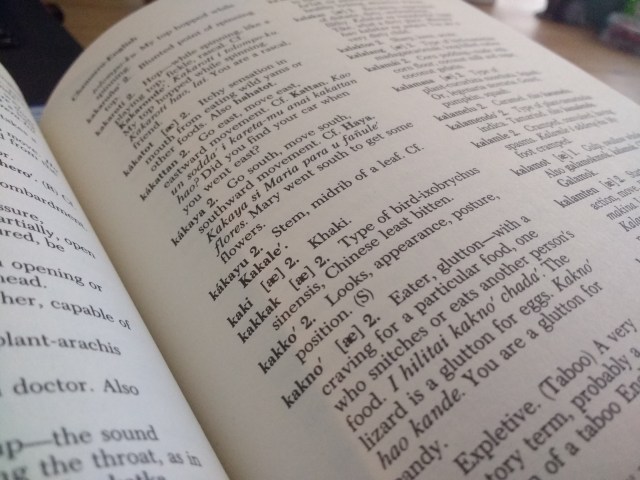
When you’re getting started, keep an eye on the words that have either a 1 or 2 after them and as a general rule, they can be used in the following ways:
- Class 1 words can be used as transitive verbs.
- Class 2 words, when used as intransitive verbs, are verbalized with -um- or ma-; these words may also function as nouns or adjectives in their root forms.
You can also read the details of these word classification definitions in the dictionary’s Introduction under 6.2 Word Classification.
Find Root Words With an Online Tool
The majority of spoken Chamorro is comprised of transformed words, which is a core feature of our language. It’s awesome and beautiful and… a bit of a headache when you’re learning, because most of these transformed words aren’t in any dictionary.
The usual process is to identify the root word and define it so we can get a general sense of the overall meaning, even if we don’t fully undestand the grammar of the transformations. To expedite this process of finding the root words, try using the tool CHamoru Morphological Analysis.
To illustrate how this works, let’s look up the word luminao. Look for the entry that has [ROOT] underneath it, because this is the tool’s guess at what the root word could be. For luminao it tells us that the root word is linao:
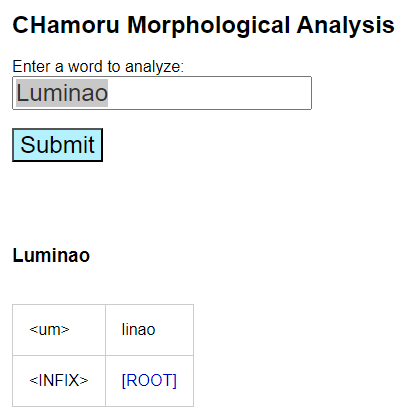
Just note that this tool is imperfect – it can’t always correctly identify the root words, and sometimes it has many guesses at identifying the root word, so you may have to sort through a few entries.
Search on Common Spelling Variations
This next tip speaks to the plentitude of orthographies that exist for our language. With all the spelling variations out there, this can also make it difficult to find words because everybody spells differently in our language.
If you’re struggling to find a word, try changing the spelling. Common spelling variations to use are:
- o –> u or u –> o
- e –> i or i –> e
- ñ –> n or ñ –> n
- å –> a or a –> å
In addition to the above, try to either add special characters, like vowels with stress marks above them. Or if your word has special characters, try removing them. Try removing glotas, or change the character you are using for the glota because not every dictionary uses the same character. Just note that some of these spelling variations may return different words entirely (ie: ma’lak vs. malak), so pay attention to the context of the Chamorro you’re trying to translate.
Refine Your Google Searches
If I’m trying to find a word, a common thing I will do is search for the word on Google. I either search for just the word, or I search for the word with either Chamoru or Chamorro in front of the word to help narrow down the searches.
Perform a Corpus Check on Electronic Media
If you’re trying to figure out how to use words, or you want to see patterns in how a word is used in native speech, I recommend doing what is called a corpus check.
Basically, a corpus check means we search for a word across a bunch of electronic, written Chamorro content to find the different ways that word is actually used in speech.
For those of us without speakers left in our families, or who are unable to be around speakers frequently, this still allows us to learn directly from speakers even when we are on our own.
To demonstrate this, I recently needed to understand how the word mañotsot is used in sentences. So I went to Påle’ Eric’s blog and searched for that word. It returned a bunch of different blog posts, so I did CTRL+F to search for mañotsot on the results. And here are all the sentences I found:
- Maolek-ña mañotsot tåtte ke ni mañotsot mo’na
- Gi me’nan i kilu’us, mañotsot, puti yo’
- Humomhom i ha’åne, sa’ ti mañotsot yo’
- Kao mañotsot hao nu todo i isao-mo siha?
- Lao mañotsot yu’ magåhet
- Mañotsot i anti-ho, hu setbe hao Nanå-ho
- Mañotsot yo’ nu todu i isao-ho
- Ensegidas sangåne si Yu’us na manmañotsot hamyo nu i en isague gue’
From this, I learned a lot of things all at once: I can see that the word mañotsot is commonly in the Verb-Subject structure; when paired with pronoun subjects it is using the yu’ type pronouns; it takes a plural man- prefix when referring to 3+ people; and this word is used in a Chamorro proverb (the first entry), so this tells me that it could be a frequently used or important word.
For this, I highly recommend only using trustworthy sources from native or highly fluent speakers. The content that I frequently use to perform a corpus check is all linked below:
- Påle Eric’s Blog
- Sandra Chung’s Chamorro Grammar
- Collection of Sermons from Bishop Tomas Camacho
- Transcripts from the Hongga Mo’na Interviews
- Guam PDN news articles written by Peter Onedera
- Sunday Readings in Chamorro from the Diocese of Chalan Kanoa
- Istoria Sagrada edited by Påle’ Roman de Vera
- Istreyas Marianas: Chamorro by Joaquin Flores Borja, Manuel Flores Borja, and Sandra Chung
- Chamorro-English Phrase Book by Påle’ Roman de Vera
I also try to put as much content as possible on my Kindle, because when I search for a word on my Kindle it will search across everything on my device. Anytime I come across a good piece of written content, I’ll just send it to my Kindle for later reference.
Do Reverse Searches on the Chamorro Bible
In addition to wanting to see how a word is used, we may also want to learn how to express certain kinds of thoughts in Chamorro. For things that are more complex like this where we may not know where to start, I like to do what I call a reverse lookup using the Bible.
For example, recently I was curious about the different ways of expressing the idea of “becoming” in Chamorro, such as “you will become my queen” or “he became king.”
Then I went to BibleGateway.com and searched on the word “became”, with the New King James Version selected:
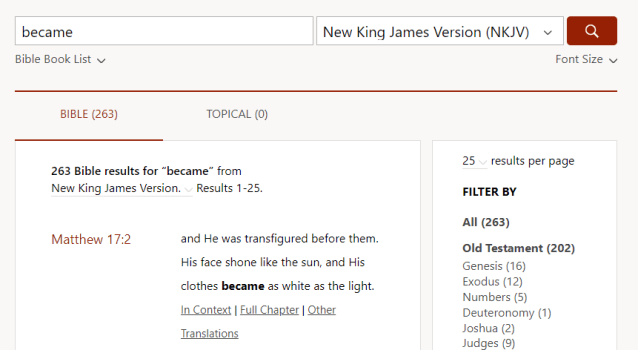
The results return every bible verse that has my word. I look across the New Testament results and select the verses that seem to approximate the thought I want to express. In this case, the verse Luke 6:16 “Judas the son of James, and Judas Iscariot who also became a traitor” is closest to what I was looking for. Then I look up that same verse in my copies of the New Testament in Chamorro. And I get this:
si ‘Judas’, lahen Santiago, yan si ‘Judas’ Iskarioti, ni humuyong traidot.
From this, I learn that humuyong gives us one way to say “became” in Chamorro. Then I experiment with using this structure and insert my own words:
i lahen tåsi, ni humuyong rai = the son of the ocean, who became king
In another verse, the prefix mama’- was used to indicate becoming something, such as in Luke 22:44: “Then His sweat became like great drops of blood falling down to the ground.” The Chamorro version looks like this:
i masahalom-ña mama’håga’ ni tutuho’ gi edda’
And then we can play around with this form again to make our own sentences:
mama’atdao i atadok-ña = his eye became the sun
This method is slower than the rest because I tend to use my physical copy of the New Testament, but it yields some extremely worthwhile and beautiful results.
Ask Your Study Group
If you are going to be seriously studying and learning Chamorro, I do recommend that you join some kind of study group or practice group. And if you can’t join an existing group, try to form your own! Learning Chamorro really is much better and faster if you have a group of like-minded people around you! For questions like trying to figure out what a word or phrase means, being part of a group is a great way to potentially get an answer relatively quickly while also helping the entire community learn.
Ask Reddit
And finally, if you are a bit shy and don’t want to join a group, and you still can’t find the word you’re looking for, I suggest asking for help on the Chamorro language subreddit (this is a different space from the Guam and Chamorro subreddit) https://www.reddit.com/r/CHamoru/ I have definitely asked for help here, and people have very kindly answered my questions over the years.
It may seem quiet on that page, but trust me, there’s a group of us who will come out of the woodwork to answer questions and help when needed 🙂
 Lengguahi-ta