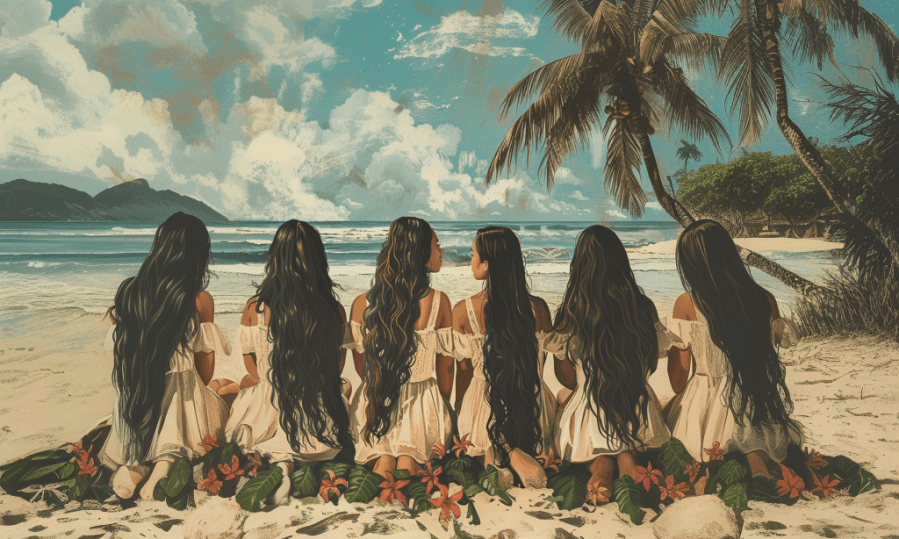
Here is a Chamorro legend that tells us why the middle of the island of Guam is so skinny. It is definitely a beloved legend, as it celebrates the intelligence and courage of Chamorro women. This version combines storytelling from two different versions of this legend I found in the KPV Collection in their Education & Culture Content section (sources detailed below). But the majority uses the version from Dolores I. Marciano.
In this post you’ll find the Chamorro text, a Chamorro audio narration by Jay Che’le, an English translation, and a Quizlet flashcard set for learning the affixed words. Happy reading!
I Famalao’an Guahan Yan i Tano’-ñiha
Ginen i tinige’ siha si Dolores I. Marciano yan si Carmen C. Blas
Buente guaha trenta miyas inanako’-ña Guahan ya guaha lokkue’ sais miyas inancho-ña ya dumálalai gi talo’. Yanggen ma’á’atan Guahan ginen i aire, annok na kalan inakka’ todu i dos bånda, ginen i sanlichan na bånda giya Hagåtña asta i sankattan na bånda giya Pågo. Taimanu na taiguini Guahan posision-ña, masångan gi taiguini mo’na na manera:
Åpmam na tiempo giya Guahan, guaha mansenmetgot na klåsen taotao ni manmafa’nána’an Taotaomo’na. Este siha na taotao mansenmetgot yan mansentomtom. Todu klåsen åtte siña ma cho’gue para i minaolek i taotao-ñiha.
Un diha, ma sodda’ na guaha kumåkånno’ i tano’-ñiha ginen i dos bånda, Pågo yan Hagåtña. Ma líli’e’ lokkue’ na kada diha mås ti parérehu esta i inancho-ña yan i dinangkulo’-ña iya Hagåtña yan Pago na Båkåna. Kada diha mås dádalalai i tano’.
“Yanggen sísigi ha’ taiguini, siempre u ma’tot i tano’-ta. Nisisita ta espiha håfa para ta patang i kumåkånno’ i tano’,” ilek-ña i taotao.
Ma’ågang i hunta, ya todu i manmalåte’ manmåtto. “Håfa para ta cho’gue para ta na’libre i tano’-ta?” sigi manáfaisen i taotao siha. Sigi manáfaisen håfa para macho’gue. “Yanggen sigi ha’ kinanno’ i tano’ nu este na ná’ma’a’ñao kosas, siempre humuyong este i tano’-ta madibiden dos,” sigi manásangåni.
Gi annai manhúhunta, måtto’ un taotao ya ilek-ña, “Guaha un dångkulo’ na guihan ni anakko’-ña kini tres taotao yanggen manå’åsson. Este na guihan kumåkånno’ i tano’ Guahan, umesgen kånton Pågo na båkåna ya sigi ha kånno’ i manmañaña na påtte gi kanton i båkåna. Ha ú’upos i ekso’ ya ha kåkånno’ i kanton tåno’.”
“Debidi ta aligao este na guihan ya ta puno’ sa’ peligro para i tano’-ta,” ilek-ña i ma’gas i taotaomo’na. “Todu i manmetgot na taotao u fanhuyong ya u fanmanasiste guini na cho’cho’.”
Manhånao meggai na manmetgot yan manfuetsudu na lalåhi para Pågo, manmañúñule’ meggai flecha, se’se’, tokcha’, lansa, yan haguet ni mansen malaktos. Manma’udai gi mandångkulo’ na galaide’ ni mansen chaddek yanggen mapoksai, yan manhånao huyong asta i tasi para u ma espiha i enemigon-ñiha na guihan. Ha’åne yan puengi, duru i taotao di manmanalíligao nu i guihan gi galaide’-ñiha, lao ti ma sósodda’ sa’ umá’atok i guihan kada manlini’e’ siha.
Los uttimo, manhånao tåtte i lalåhi para i tano’-ñiha. Esta sen åpmam desde ki ma alíligao i guihan, lao ti siña masodda’. Manggof chatsaga hinasson-ñiha sa’ ma tungo’ ha’ na siempre u linachai i tano’ kinanno’ ni guihan.
“Buente estague’ para uttimo-ta todus,” ilek-ña un taotao.
“Yanggen sigi ha’ ha kånno’ i ga’ga’ este i tano’-ta, siempre ta fanmåtai todus,” ilek-ña i otru taotao.
Manásangåni todu i taotao siha gi tano’ put i guihan, ya måtto guatu annai mañáñangu i manhobensita siha na famalao’an giya Guahan. Sesso este siha na famalao’an manhånao ya mano’mak gi halom såddok giya Hagåtña. Sesso manetnon ya mangånta, manguentos yan mañålek gi kanton i saddok. Ma fa’gågåsi i anakko’ na gapotulon-ñiha gi halom i klaru na såddok. Ma na’sésetbe i chigo’ lemón para u ma hinagua i gapotulon-ñiha, pues ma yúyute’ i lassas lemón siha hålom gi saddok.
Un diha, ma sodda’ i lassas lemón siha na manmama’ya gi halom hånom giya Pågo.
“Yanggen siña ta sodda’ i lassas lemón guini mågi, pues kumekilek-ña na i guihan ha kåkånno’ i isla ginen papa’,” ilek-ña i un palao’an.
“Siña ha’ i guihan humåhånao ginen bo’bo’ Hagåtña asta Pågo na båkåna. Siempre u huyong este i tano’-ta ma’tot entot siha na pidåsu,” ilek-ña ta’lo i palao’an.
I famalao’an manetnon, ya sigi ma diskuti put i tano’-ñiha yan i guihan. “Ti siña håfa i lalåhi u ma cho’gue para u ma kókonne’ i guihan. Buente mantomtomña hit kini este na guihan,” ilek-ñíñiha i famalao’an.
“Yanggen siña i lassas lemón u gama huyong asta Pågo, pues siña ha’ i guihan u gama lokkue’ hålom guini gi saddok,” ilek-ña i un palao’an.
Ya ilek-ña otro, “Tåya’ i lalåhi siña ma cho’gue sa’ todu esta macho’gue. Nihi fan ya ta cho’gue håfa nina’siñå-ta.”
“Magåhet! Magåhet!” manessalao i famalao’an. “Po’lo ya u hånao mågi, pues eyu na ta chagi kumonne’.”
Unu gi famalao’an dumisidi håfa para u macho’gue’, ya humuyong mangomfotme todu i pumalu siha.
Ma utot i anakko’ na gapotulon-ñiha ni sen bonitu, ya matufok para chenchulu. Gi annai esta sen dångkulo’ gi todúdu direksion, ma chule’ ya manmatå’chong papa’ gi kanton såddok ya sigi di mangånta.
Sigi i famalao’an mangånta. Ma kåkånta i manbunitu na kånta ni ma tungo’, yan kånta ni ma fa’títinas guihi na mumento.
I guihan ha hungok este i gatbo yan sen suabe na kånta siha, sigi di muñangu’ hålom asta i saddok. Mås lumáhihot gi annai mås hóhongga i bunitu na hiningóngok-ña siha na bos. Måtto guihi na lugåt annai manmatåtå’chong i famalao’an yan i chenchulu gi kannai-ñiha, mientras mangåkånta.
Ensigidas manli’of hålom gi halom såddok ya ma plånta i chenchulu gi uriyan i guihan. Humålom i guihan gi halom i chenchulu ya sigi ha kélaknos gue’, lao todu gue’ esta gåddon.
Manmåtto i lalåhi yan i atmas-ñiha ya masen puno’ i ga’ga’. Malachai matokcha’, mataga’, yan malansa ni manmalaktos siha na atmas.
I manhoben na famalao’an Guahan muna’libre i tano’-ñiha ginen i atten gapotulon-ñiha yan i bunitu yan suabe na kåntan-ñiha. Ma cho’gue i impottånte na cho’cho’ ni etmas metgot na lalåhi ti siña ma cho’gue.
The Women of Guam and Their Land
From the writings of Dolores I. Marciano and Carmen C. Blas
There are about thirty miles of Guam’s length and also six miles of its width, and it becomes skinny in the middle. If Guam is looked at from the air, it appears as though the two sides were bitten, from the west side in Hagåtña to the east side in Pågo. How Guam’s shape came to be like this, it is told this way, in the following manner:
For a long time on Guam, there were an extremely strong type of people who were called “the people of before” (ancestors). These people were extremely strong and intelligent. They could do all kinds of magic for the good of their land.
One day, they found that there was something eating their land from the two sides, Pågo and Hagåtña. They were also seeing that every day, its width and size in Hagåtña and Pågo Bay were increasingly different. Every day the land was getting skinnier.
“If it keeps on like this, our land will definitely be severed. We need to search for something to block what is eating the land,” the person said.
A meeting was called, and all of the intelligent ones arrived. “What will be done to free our land?” the people kept asking each other. They kept asking each other what would be done. “If the land continues to be eaten by this scary thing, our land will definitely become divided in two,” they kept saying to each other.
When they were all meeting, a person arrived and he said, “There is a big fish, whose length is greater than three people laying down. This fish is the one eating the land of Guam, it passed through the edge of Pågo Bay and it kept eating the soft parts of the edge of the bay. It is passing the hill and is eating the edge of the land.”
“We must search for this fish and kill it because it is dangerous to our land,” the chief of the ancestors said. “All of the strong people will go out and will help here in this work.”
Many strong and powerful men went to Pågo, taking many bows and arrows, knives, spears, lances, and fish hooks that were well sharpened. They rode in big canoes that were extremely fast when they paddled, and they went out to the ocean to search for their enemy fish. Day and night, the men kept searching for something of the fish in their canoes, but they were not finding it because the fish was hiding every time they were seen.
In the end, the men went back to their land. It had already been a very long time since they were searching for the fish, but it could not be found. Their thoughts were strained because they already knew that the land would definitely be completely eaten by the fish.
“This will probably be our end,” a person said.
“If the animal continues to eat our land, surely we will all die,” another person said.
All of the people on the land spoke to each other about the fish, and it arrived there where the young women were swimming on Guam. Often these women went and bathed in the river in Agaña. They often gathered together and sang, talked, and laughed on the riverbank. They were washing their long hair in the clear river. They were using the lemon juice to rinse their hair, then they were throwing away the lemon skins in the river.
One day, they found that the lemon skins were floating in the water at Pågo.
“If we can find the lemon skins here where we are, then it means that the fish is eating the island from the bottom,” a woman said.
“It can be that the fish is going from the Agaña water source to Pågo Bay. Surely our land will become chopped to pieces,” the woman said again.
The women gathered and they continued to discuss their land and the fish. “The men can’t do anything to catch the fish. Maybe we are smarter than this fish,” the women were saying.
“If the lemon skin will float out to Pågo, then it can be that the fish will also float inside here in the river,” a woman said.
And another said, “There’s nothing the men can do because everything has already been done. Let’s go and we will do what we can.”
“True! True!” the women shouted. “Let it come here, to where we are, then that is where we will try to catch it.”
One amongst the women decided what would be done, and it came to be that all of the rest agreed.
They cut their long hair, which was very beautiful, and it was woven for a net. When it was already very large in all directions, they took it and they sat down at the riverbank and they continued to sing.
The women continued to sing. They were singing the beautiful songs that they knew, and the songs that they were making in that moment.
The fish heard these splendid and superb songs, and continued to swim in to the river. It was getting even closer to where the beautiful voices it was hearing were more audible. It arrived at that place where the women were sitting with the net in their hands, while they were singing.
They quickly dove into the river and they spread the net around the fish. The fish entered into the net and it continued to try to get itself out, but all of it was already entangled.
The men arrived with their weapons, and the fish was fully killed. It was thoroughly speared, sliced, and lanced with the sharp weapons.
The young women of Guam were the ones who freed their land through the magic of their hair and their beautiful and splendid songs. They did the important work which the strongest men could not do.
Study Resources
Quizlet Flashcards for Affixed Words: https://quizlet.com/891032867/i-famalaoan-guahan-yan-i-tano-niha-affixed-words-flash-cards
References
Blas, Carmen, trans. 1978. “Hafa Taimanu I Mañottera Annai Masatba Guam.” PDF. In Legend Fino’ Chamorro Siha. Guam Secondary Bilingual Education Project. https://airtable.com/appU43QeD409YS6Hl/shrXhl6F1kRn9xx1H/tblQeLirqavda9h6P/viwh0oCoEpAZEH4XG/recEkBAfmW0rCSlHF/fldWSwclEvY9lGVlu/attZMRjxsDfGeiY5Q?blocks=hide.
Marciano, Dolores. 1975. “I Famalao’an Guam Yan I Tano-niha.” PDF. In ESTORIA SIHA GI FINO’ CHAMORRO, 21–26. Kiu Press. https://airtable.com/appU43QeD409YS6Hl/shrXhl6F1kRn9xx1H/tblN01VTDCNtsL5Er/viweMEfQRRSfWjSvi/recvGRndQnJwJxlc2/fldJcH5PQ1juSBRbo/att5w0I2cILnKFpPH?blocks=hide.
YouTube Video
You can also listen to the story and read along on YouTube!
 Lengguahi-ta