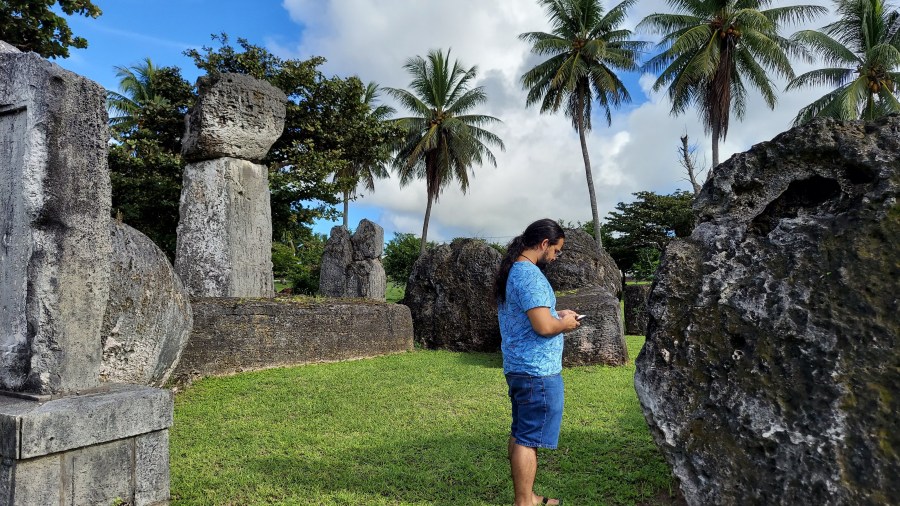
A big part of my own Chamorro language learning journey has been reading and collecting books and articles about the Mariana Islands. One gorgeous book I recommend reading is “Latte in the Marianas”, which you can purchase from the Guampedia Heritage Gift Shop. The majority of the book is written in English, but there are two essays written in Chamoru with English translations included. This is one of those essays, written by Påle’ Eric Forbes, about the Latte/Latti stone. It can be difficult to find long-form written Chamorro (other than the Bible), so this essay gave our study group some excellent practice. The narration for this is done by Jay Che’le. Listen and enjoy!
Latte/Latti, Haligi, yan Tåsa
Tinige’ as Påle’ Eric Forbes
Yanggen manmafaisen i taotao siha para u ayek unu ha’ na imåhen para u riprisenta i taotao Chamoru, meggai na taotao umayek siempre i latte. Annai i taotao ma li’e’ i latte, siempre u ma hasso taotao Chamoru yan guaha maolek na rasón para ennao. Solu gi i islas Marianas nai siña ma sodda’ i latte. Espesiåt na guinaha ni iyon taotao Chamoru ha’. Yanggen un atan i ifisiåt na seyon i Commonwealth Sangkattan na Islas Marianas, siempre un li’e’ i latte. Giya Guåhan, siña un li’e’ i latte gi tapbleru siha ni mana’tátachu annai guaha manmalǻlågu para gubietnu, sinadót pat atkåtde. I sagan bås manmahåtsa gi i hichuran latte, yan haligi siha ni humáhåtsa i manmodetno na guma’ påddet fihu macho’gue gi i hichuran latte. I latte numa’fanmanháhasso hit nu i taotao Chamoru.
Anåkko’ na tiempo åntes di i finatton i Españot giya Marianas, manmama’títinas latte i mañainå-ta. Siña ta sodda’ siha gi kana’ ha todu i islas giya Marianas. Guaha tres na fino’ ni manempottånte para ta tungo’ put i latte. Fine’nina, i finiho’ latte, ni masåsångan para enteru i haligi ni mafotma gi i dos pidåsu. Put i fino’ haligi, nu i kumeke’ilek-ña i patten sampapa’, osino i haligen åcho’, ni ha fófotma i fendasion i latte. Alos uttimo guaha tåsa, osino i sanhilo’ na påtten i latte ni sesso kulan mediu sitkulu hichurå-ña. Mangginen amånu mågi este siha na fino’?
Latte / Latti’
Åpmam na tiempo tåtte, håfa na nå’an ma nå’i i mañainå-ta ni este siha na haligi ni dos patten-ñiha ni manmafa’tinas ginen i acho’? I etmås siguru ni siña ta ålok amånu ma fa’na’an siha latte. Mañasaonao hit gi un gurupon taotao siha ni mamparientes put meggai mit åños yan i taotao Taiwan, Filipinas yan i Sanhaya na båndan Åsiha gi Sampapa’. Achokka’ unos kuåntos na lengguåhi ni manmasåsångan gi este siha na lugåt guaha palabrås-ñiha na kulan hihot yan latte. Tåya’ ni unu gi iya siha kumeke’ilek-ña haligen åcho’. Giya Filipinas, i taotao Ifugao ma po’lo i pigas-ñiha gi i halom mandídike’ guma’ ni mangkinahat nu i haligen håyu ni kulan parehu pusision-ñiha yan i latte, lao ti latte na’an-ñiha na maktingan, yan magåhet na guaha na manmafa’tinas i latte ginen i acho’ maktingan. Pues, kao kumeke’ilek-ña latte i dos na pidåson haligen åcho’ pat i matiriåt ni ma’ú’usa para i mafa’tinås-ña? Hokkok ha’ tiningo’-ta na latte i na’ån-ña este na haligi gi i fino’ Chamoru.
Haligi
Gi i fino’ Chamoru, haligi kumeke’ilek-ña tunas yan lokka’ na pidåson håyu, åcho’ pat otro siha na matiriåt, yan gi i latte i haligi gi i takpapa’ na påtte ni ha fófotma i fendasion i dos na pidåson haligen åcho’. Gi i magåhet, este na fondasion haligen åcho’, maskeseha mapannas pat aridondo pat kuadrao, maskeseha dikiki’ pat dångkolo. I palåbra haligi ha na’á’annok i hihot na pumarientes-ta yan i pumalu na taotao siha ni mañåsaga gi este na båndan i tano’. Kada uniku na ihemplo, parehu ha’ seknefakasion-ña i fino’ haligi gi i fino’ Tagålog yan gi i fino’ Chamoru. Guaha lokkue’ lengguåhi giya Indonesia annai guaha fino’-ñiha “arihi”, ni hihot yan i palåbra haligi, ya parehu ha’ seknefekasion-ñiha i dos palåbra.
Tåsa
I patten sanhilo’ gi i latte mandifirentes klåsen hichura, lao meggai biåhi aridondo na pidason åcho’ ni todu tiempo yånu i sanhilo’-ña. Yanggen un atan este gi un bånda, kulan mohon tåsan gumimen pusision-ña. Buente ennao mina’mafa’na’an tåsa este na påtten sanhilo’-ña. Siña buente ma ayao i palåbra tåsa ginen i fino’ Españot sa’ guaha palåbra fino’ Españot “tåsa” ni parehu seknefakasion-ña yan i tasan gumimen. Ombres i Españot siha umayao este na palåbra ginen i taotao Arab sa’ guaha palåbran-ñiha “tassah” nu i kumeke’ilek-ña tåsa pat tason. Hagas guaha este i patten sanhilo’ gi i latte åntes di i finatton Españot giya Marianas, pues håfa na’ån-ña gi fino’ i mañainå-ta? Astaki ta sodda’ la’meggai na mambihu na dåkumento ni ta tungo’ håfa siha trabiha, ti siña ta oppe este. Lao guaha siha na taotao manmalago’ na ta tutuhon fuma’na’an este i sanhilo, sesso aridondo na påtten i acho’ latte i “ha’iguas,” ådiset i ha’iguas niyok, sa’ aridondo lokkue’ i ha’iguas, ya komu, un chåchak gi i dos påtte i ha’iguas, kulan parehu pusision-ña i lamitå påtte yan i acho’ ni matåtå’chong gi i hilo’ i latte.
Latte/Latti, Haligi, and Tåsa
Written by Father Eric Forbes
If people were asked to choose just one symbol of the CHamoru many people would choose the latte. When people see the latte, they always think of the CHamoru people and there is a good reason for that. Only in the Mariana Islands can one find latte. It is a special treasure that belongs just to the CHamoru people. If you look at the official seal of the Commonwealth of the Northern Marianas, you will see the latte. On Guåhan one can see the latte on the signs people put up when they run for governor, senator, or mayor. Bus stops have been made to look like latte, and the pillars that hold up modern, concrete buildings are often made to look like latte. The latte makes us think of the CHamoru people. Long before the Spanish people came to the Marianas, our ancestors were making latte. We can find them in nearly all of the islands in the Marianas. There are three words that are important to know about the latte. First, there is the word latte, which is used for the whole, two-piece, stone pillar. Then there is the word haligi, which means the bottom part, or stone post, that forms the base of the latte. Then finally there is the tåsa, or the top part of the latte that often looks like a half circle. Where do these words come from?
Latte / Latti
What name did our ancestors long ago give to these two-picce pillars which they carved from rock? The best we can tell is that they called these pillars latte. We really do not know why our ancestors called them latte. We belong to a group of people who are related over many thousands of years to people in Taiwan, the Philippines and Southeast Asia. While some of the languages spoken in those places have words that sound a bit like latte, none of those words mean a stone pillar. In the Philippines, the Ifugao people store their rice in sheds held up by wooden posts that look somewhat like latte, but these posts are not called latte. Some older CHamoru people say that latte means coral rock, and a lot of latte were carved from coral rock. So does the word latte mean the two piece stone pillar itself, or what it is made of? All we know for now is that the pillar is called latte in CHamoru.
Haligi
In CHamoru, haligi means post’ or column’ and, in the latte, the haligi is the lower part which forms the base or foundation of the two-piece stone pillar. This base or foundation is in fact a stone post or column, whether it be flat or rounded or box-like, or small or big. Haligi is a word that shows just how closely related we are to people in the region. Just as one example, the Tagalog people in the Philippines also use the word haligi and, for them, the word haligi also means ‘pillar, post, or column, just as we say in CHamoru. There is even a language spoken in Indonesia where their word for pole’ or post’ is arihi, which sounds very much like haligi.
Tåsa
The upper part of the latte can be different shapes, but is often a rounded stone, and always has a flat top. Looking at it from the side, this top part can look like a drinking cup or bowl. Perhaps because of that, this upper part is now called a tåsa. The word tåsa is probably borrowed from the Spanish language, because taza in Spanish means ‘cup’ or bowl’ Even more surprising is that the Spanish people borrowed this word from the Arabs, whose word for ‘bowl’ is tassah! The upper portion, or cup-like top, of the latte existed long before the Spanish came to the Marianas, so what was the word used by our ancestors for it? Until we discover more old documents we may not know about yet, we do not know. But some people would like to start calling the top, often round part of the latte stone, the ha iguas, which means a coconut shell, because the ha’iguas is round and, if you cut it in half, it looks like the half circle rock that sits on top of the haligi in a latte.
References
Marsh, Kelly G. 2021. Latte in the Marianas: By the Community for the Community.
 Lengguahi-ta