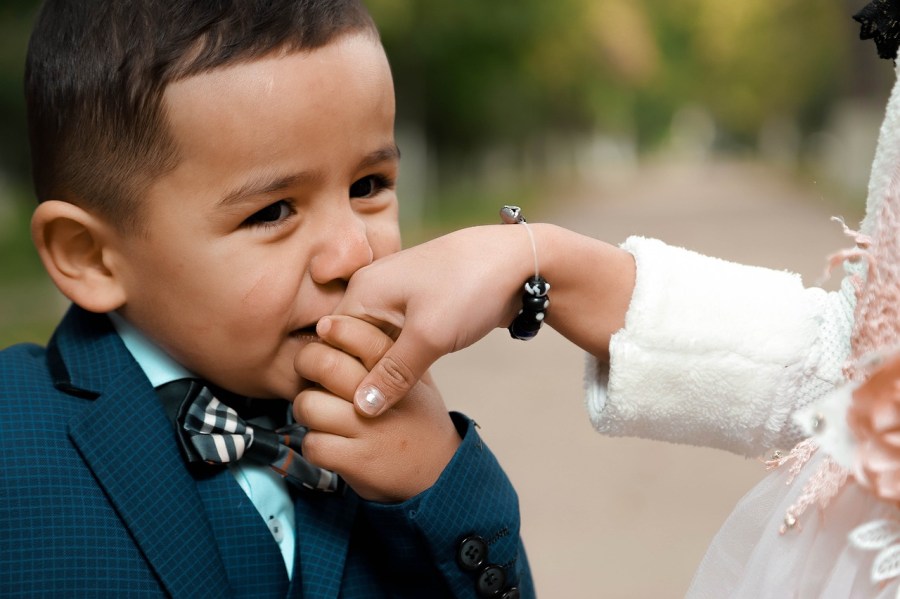
When you were growing up, did you practice the Chamorro custom of respectfully greeting elders by taking their hand and sniffing it? In my family we would just go around giving hugs and kisses to our elders, so when I was introduced to this custom I wasn’t used to it at all! Here is a short story in Chamorro about this custom, written by Carmen C. Blas, from a book about Chamorro customs that I found in the KPV collection (the direct link to the entire PDF can be found under the References for this post). If you would like to learn more about the mannginge’, I have also included a short list of free, online resources for further reading on this Chamorro custom.
This post includes the Chamorro text, an English translation of the story and a Chamorro audio narration by Jay Che’le. Happy reading!
I Kostumbren Mannginge’
Tinige’ as Carmen C. Blas
Pinentan as Lita Payne
Desde antétes gi tiempon Españot, guaha kostumbren i Mañamoru ginen i Españot ni yanggen manásodda’ i manhoben yan i manåmko’, mago’te kannai-ñiha i manåmko’ ya manmannginge’ i manhoben. Esta pápå’go ha’ na tiempo guaguaha ha’ este na kostumbre.
Achokka’ ti amko’ lokkue’ i taotao, yanggen tihu pat tihå, manmannginge’ ha’. Guaha nai åmko’-ña i subrinu pat i subrina ki i tihå pat i tihu.
Meggai na manhoben esta ti yan-ñiha pat manmamåhlao manmannginge’, buente ti mangof rekto i mañainan-ñiha. Guaha na mañaina yanggen ti manmannginge’ i famagu’on-ñiha, manmakastítiga lao guaguaha ha’ famagu’on ni yan-ñiha ha’ manmannginge’.
Meggai na okasion nai ma’u’usa este i mannginge’, yanggen på’go umali’e’ i dos taotao ya unu åmko’, otro hoben, pat unu tiha pat tihu. Yanggen lokkue’ ginen i gima’yu’us, nobena pat lisåyu, pat maseha håfa na tinaitai, manánangga na u guaha mannginge’. Yanggen måtto i dos taotao ginen umasagua, mana’dimu gi salan i gima’ gi hilo’ guafak ya mamila i manåmko’ para u fanmannginge’. Yanggen måtto lokkue’ i patgon ginen matakpångi, mana’líliko’ gi manåmko’ para u mana’fannginge’.
Este i mannginge’, gof bonito na kostumbren i Mañamoru ya maolek buente mana’la’metgot. Dångkulu na respetu manmannånå’i i manåmko’ yanggen manmannginge’.
The Custom of Showing Respect1
Written by Carmen C. Blas
Illustrated by Lita Payne
Since way before in the Spanish times, there has been a custom of the Chamorros from the Spanish that when the youth and the elders meet each other, the hands of the elders are held and the youth smell them. Up until these times now, this custom still exists.
Even, too, though the person is not old, if they are an uncle or aunt, they still show respect. Sometimes the nephew or niece is older than the aunt or uncle.
Many young people already do not like to, or they are embarrassed to show respect, because their parents probably are not very strict. There are parents who, if their children do not greet with respect, they punish them, but there are still children who still like to greet with respect.
This custom of showing respect is used on many occasions, if two people see each other for the first time and one is old and the other is young, or if one is an aunt or uncle. Also in coming from church, a novena or rosary, or any kind of prayer, they will wait for there to be the custom of showing respect. If two people arrive from getting married, they will be made to kneel in the living room of the house on top of a woven mat and the elders will line up for the custom. If a child also arrives from being baptized, he/she is made to go around to the elders to be given the greeting.
This showing of respect is a beautiful custom of the Chamorro people and it’s good that it should probably be made stronger. A lot of respect is given to the elders when their hands are smelled.
Endnotes
- mannginge’: The word mannginge’ comes from the root word nginge’ which means “to smell.” In this context, mannginge’ is the custom of showing respect to elders by taking their hand and smelling it. ↩︎
References
Blas, Carmen C. Mangadada’ Siha Na Estori’a Pot I Kutturan Guam: Social Studies Grades 7, 8, & 9. PDF. Agana, Guam: Department of Education, 1977. https://v5.airtableusercontent.com/v3/u/49/49/1769551200000/_RdE-DRhCQQjwHiqZTbHIQ/UQeeQm8JrGbzLL7QVDGkZXIpVyzumS2IiPjegnVerBKnRy5MwA-ZJ591q7obSx_c9tl1iLWeV-MiSU9SZSBiwKK0z39v0NtpKlWOqO_MEFv0vYO7qM9nZYA6lNad2tf2nEJxrVIzjqdh8NGEjhJK9mGB9RLMqEjY93H6faJJwrylXFtFzE_PFU_gZC0x-PSlcs-4QTsqF_TiReyYCV25C8l_nRUTsp7OmbnkTkuiHjg/27tcu3NOuCPdLsBxL1pVh78LqeSYr2fBEkSDYzG-HF4?acrobatPromotionSource=embeddedpdfs_chrome-native_view
Further Reading
Aguon, Julian. “Nginge’: Showing Respect.” Guampedia. Accessed January 27, 2026. https://www.guampedia.com/nginge/.
Forbes, Eric. “THE MANNGINGE’ : Defining the Relationship.” Paleric, March 22, 2011. Accessed January 27, 2026. https://paleric.blogspot.com/2011/03/mannginge-defining-relationship.html.
 Lengguahi-ta
Adahi i dinilitreha-mu nu “mannginge'”. Fatta unu na “N”. I diferensia: 1) MANNGINGE’ – to perform gesture of respect, 2) MANGINGE’ – to be smelled.
Lokkue’, impottante na ta sångan na an malago’ hit na para ta kuentos pot i kostumbre, debi di ta na’setbe i palåbra “mannginge'”, sa’ an “nginge'” ha’, ayu na kumeke’ilek-ña “smell”.
Pot ihemplo:
1) Mannginge’ yu’ gi as tihu-hu. I showed respect to my uncle. Or, in Chamorro English, I amen-ed my uncle. LOL
2) Hu nginge’ si tihu-hu. I smelled my uncle.
Tinago’:
1) Fannginge’! (Come, take my hand and show me respect.)
2) Nginge’! Smell it (and tell me how it smells)
Lokkue’, I like the use of the word FAÑUDA’AN for “CONTENTS”. It’s the first time I’ve seen that. Normally, I’d use GUINAHA (resources) or even SINAHGUAN (contents), so seeing FAÑUDA’AN is fun. If I translate it correctly, I understand it as a SPILLAGE or a DUMPING, which is very amusing if you imagine the author spilling the contents of her work onto the page.
LikeLiked by 1 person
Ai, dångkolu’ na Si Yu’os Ma’åse put este! Hu tulaika i dilitrehå-hu nu “mannginge'” gi este na post, ya hu po’lo i mina’dos na “n” gi palåbra. Magåhet, ti hu ripåra na guaha dos na “n” gi palåbra, sa’ ti hu hungok gi titanos-hu. Malago’ yu’ sumångan “I amen’d my uncle” pat “I respectfully greeted my uncle”, ti malago’ yu’ sumångan “My uncle was smelled” LOL.
Ya magof yu’ na un pula i palåbra “fañuda’an” sa’ ti hu gof tungo’ håfa masåsångan. Gi fine’nina, pine’lo-ku na matulaika i dilitrehå-ña nu “fañodda’an”, lao ya-hu lokkue’ “a spillage of contents” 🙂
SYM ta’lo, hu gof agradesi hao
LikeLike
Pingback: 25 Phrases for Greetings and Goodbyes in Chamorro – Lengguahi-ta